Free tool

Coop size calculator

Coop listings often promise more hens than the floor holds. Enter your birds and, if you like, the inside measurements of the coop and run, and compare them with Penn State Extension’s minimums, University of Minnesota Extension’s range and the common 4 + 10 rule.

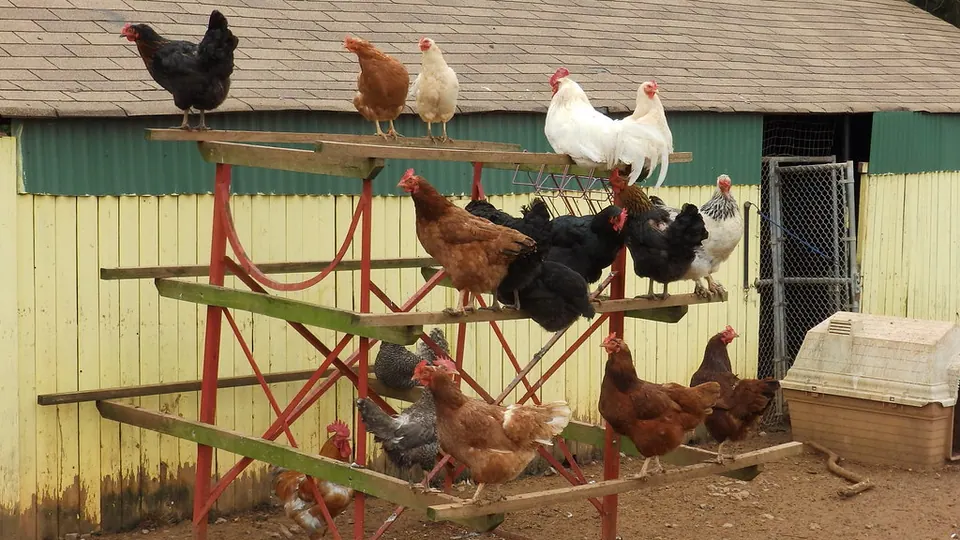
Hens lined up on a red roost ladder outside a green-and-yellow hen house
Photo: rikkis_refuge, CC BY 2.0, via Flickr
Your birds
Leghorns, Australorps, Rhode Island Reds, sex-links and similar.
Brahmas, Jersey Giants, Cochins, Orpingtons.
Will my coop fit? (optional)
Measure the floor inside the coop, not the outside footprint, and leave out nest boxes that stick out.
Space your flock needs, by norm
NormCoop floorRunYour coop
Roost length—
Nest boxes—

Norms: Penn State Extension, Small-Scale Poultry Housing, Table 1 (Minimum Space Requirements for Poultry); University of Minnesota Extension, Raising chickens for eggs (“a minimum of 3 to 5 square feet of indoor space per bird”); Widely repeated hobby guideline (4 sq ft inside, 10 sq ft in the run per standard chicken), e.g. GRIT, Chicken Coop Space Requirements. Roosts and nests: Penn State (6 in per standard bird, 4 in per bantam) and UMN cold-weather guidance (9 in per chicken); nests per Penn State (2 for the first 4 hens, +1 per 4 more) and UMN (1 per 4–5 hens).

Why three numbers?

Published space figures disagree because they answer different questions. Penn State’s table gives minimums per bird type; UMN suggests 3 to 5 square feet indoors per bird; many hobby guides repeat 4 square feet inside and 10 in the run for standard chickens. Seeing them side by side tells you whether a coop is tight, fair or roomy.

Space per bird, square feet: inside the coop / in the run

BirdsPenn StateUMN4 + 10 rule
Standard laying hens1.5 / 83–5 / —4 / 10
Large breeds2 / 103–5 / —4 / 10
Bantams1 / 43–5 / ——
Ducks3 / 15——
Geese6 / 18——
Quail1 / 4——

Sources: Penn State Extension, Small-Scale Poultry Housing, Table 1 (Minimum Space Requirements for Poultry); University of Minnesota Extension, Raising chickens for eggs (“a minimum of 3 to 5 square feet of indoor space per bird”); Widely repeated hobby guideline (4 sq ft inside, 10 sq ft in the run per standard chicken), e.g. GRIT, Chicken Coop Space Requirements. — = not given by that source.

Roosts and nest boxes

  • Penn State: 6 inches of roost per standard bird and 4 inches per bantam, roosts 1 foot apart and 18–24 inches high (bantams 12–18 inches).
  • UMN cold-weather guidance: about 9 inches per chicken, at least 12 inches above the floor, so birds can huddle in winter.
  • Nest boxes: Penn State suggests two for the first four hens and one more per four hens; UMN suggests one per 4 to 5 hens.

Measuring a coop you already have

Measure the floor inside the house, wall to wall. Leave out nest boxes that hang outside the wall and ramps. For a run, measure the area the birds can walk on. If a listing only gives outside dimensions, the real floor is smaller.

Questions

How many square feet does a chicken need?
Penn State’s minimum is 1.5 sq ft inside and 8 sq ft in the run per laying hen (2 and 10 for large breeds). UMN suggests 3–5 sq ft indoors; the common rule of thumb is 4 inside and 10 in the run.
How big a coop for 6 chickens?
For six standard hens: at least 9 sq ft inside by Penn State, 18–30 by UMN, or 24 by the 4 + 10 rule, plus a run of 48–60 sq ft.
Do bantams need less space?
Yes. Penn State lists 1 sq ft inside and 4 sq ft in the run per bantam, and 4 inches of roost.
How many nest boxes do I need?
About one per four hens: Penn State suggests two for the first four hens, then one more per four.
Are listed coop capacities accurate?
Often they assume the minimum or less. The coop product pages on this site recount each listed floor area against these same norms.

Sources

  1. Penn State Extension, Small-Scale Poultry Housing
  2. University of Minnesota Extension, Raising chickens for eggs
  3. University of Minnesota Extension, Caring for chickens in cold weather
  4. GRIT, Chicken Coop Space Requirements