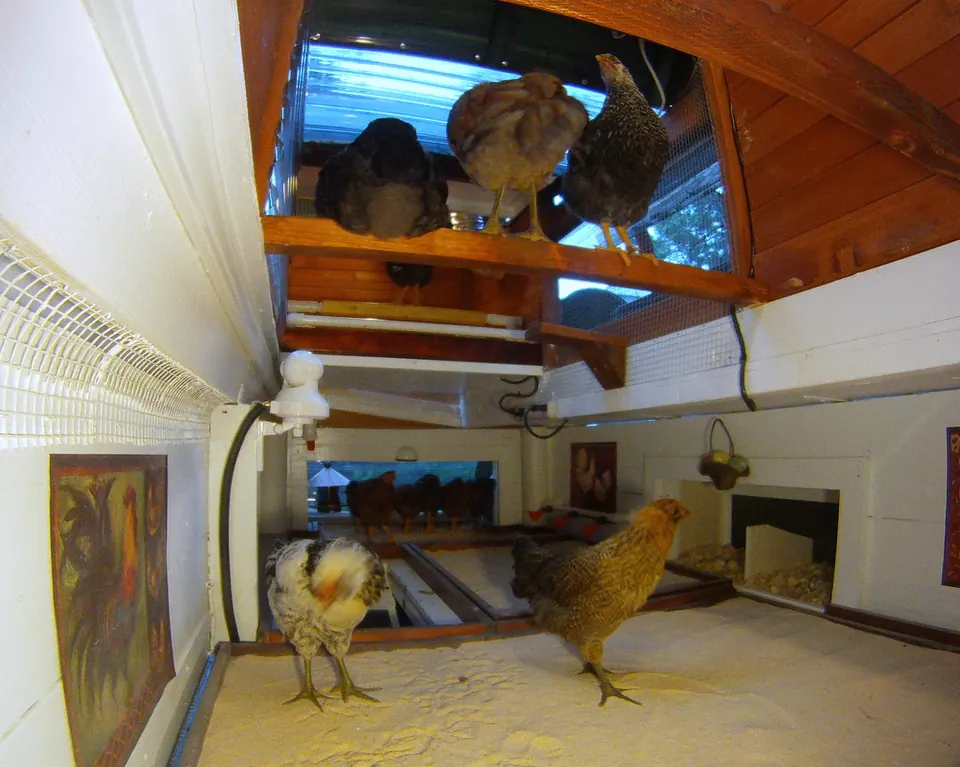
- Penn State's minimum: 1.5 sq ft per laying hen inside and 8 sq ft in the run; 2 and 10 for large breeds; 1 and 4 for bantams.
- UMN suggests 3–5 sq ft of indoor space per bird; the popular hobby rule is 4 sq ft inside plus 10 sq ft of run.
- Measure the inside floor of the house only; overall dimensions include the run and nest boxes.
- Roosts: 6 in per standard bird and 4 in per bantam (Penn State), 9 in per bird in cold weather (UMN).
- Nests: one per 4–5 hens (UMN), or two for the first four hens plus one per four more (Penn State).
How big should a chicken coop be? It depends which standard you use, and that is why online answers range from 1.5 to 10 sq ft per bird. Penn State Extension publishes a minimum for confined birds, the University of Minnesota suggests a roomier 3–5 sq ft, and many hobby guides use 4 sq ft inside plus 10 sq ft in the run.
This guide puts those norms side by side, shows how to measure a coop correctly, and recounts two listed coops against the numbers. Use it before you buy, and before you add "just two more" hens.
How much space does a chicken need in a coop?
Space per bird, square feet: inside the coop / in the run
| Birds | Penn State | UMN | 4 + 10 rule |
|---|---|---|---|
| Standard laying hens | 1.5 / 8 | 3–5 / — | 4 / 10 |
| Large breeds | 2 / 10 | 3–5 / — | 4 / 10 |
| Bantams | 1 / 4 | 3–5 / — | — |
| Ducks | 3 / 15 | — | — |
| Geese | 6 / 18 | — | — |
| Quail | 1 / 4 | — | — |
Sources: Penn State Extension, Small-Scale Poultry Housing, Table 1 (Minimum Space Requirements for Poultry); University of Minnesota Extension, Raising chickens for eggs (“a minimum of 3 to 5 square feet of indoor space per bird”); Widely repeated hobby guideline (4 sq ft inside, 10 sq ft in the run per standard chicken), e.g. GRIT, Chicken Coop Space Requirements. — = not given by that source.
The norms answer different questions. Penn State's table is a minimum: the least floor space at which birds can be housed, assuming a run outside. UMN's 3–5 sq ft is a comfortable indoor target for backyard birds that may spend bad-weather days inside. The 4 + 10 rule is a widely repeated rule of thumb with no single scientific source, but it sits inside UMN's range.
Inside floor per standard laying hen
Square feet per bird, by norm
Which should you use? If your hens free-range or have a large run, Penn State's minimum plus generous outdoor space can work. If they are confined to a small run, or you get long winters or wet seasons when they stay inside, aim for UMN's 3–5 sq ft. More room means less pecking, drier bedding and calmer birds.
How do you measure a coop's real floor space?
Measure only the inside floor of the house, where the birds sleep and shelter. Do not count the run, the nest boxes or the roof overhang. Listings often give overall dimensions, which include all of those, so a coop that is 137 in long overall may have a house that is a fraction of that.
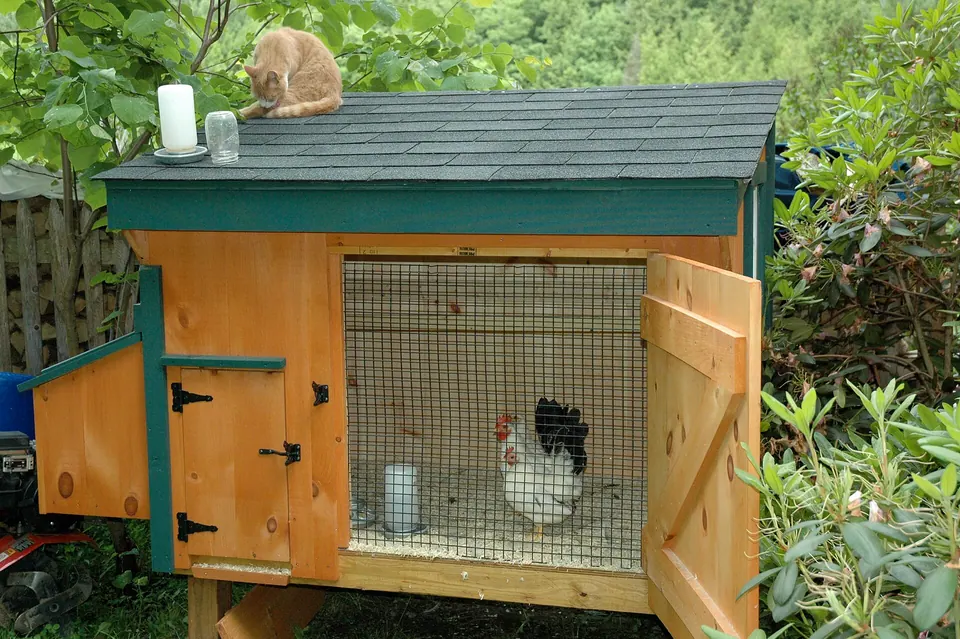
- Measure the inside length and width of the house in inches.
- Multiply them and divide by 144 to get square feet.
- Subtract any floor taken up by fixed nest boxes or ramps.
- Divide by the norm you chose (1.5, 3, 4 or 5) and round down.
Example: an interior of 41 × 36.8 in is about 10.5 sq ft. Rounded down, that fits 6 standard hens by Penn State's minimum (10.48 ÷ 1.5 is just under 7), 3 by UMN's 3 sq ft, 2 by its 5 sq ft, and 2 by the 4 sq ft rule.
Coop size calculatorEnter your birds and the coop's inside floor in inches, feet or cm to check every norm at once.Listed coops, recounted
Here are two coop listings that state their inside floor, so we can recount them. The listed hen count is the maker's claim; the box shows standard hens by each published norm.
Realistic capacity
Maker says 4–6 chickens. By the Penn State Extension minimum norm (1.5 sq ft per laying hen inside) this coop fits ≈ 6 standard hens.
| Norm (source) | Inside, sq ft per hen | Fits in the coop |
|---|---|---|
| Penn State Extension minimum | 1.5 | 6 |
| University of Minnesota Extension | 3–5 | 2–3 |
| Common 4 + 10 rule of thumb | 4 | 2 |
Coop floor 10 sq ft (listing: interior ~41 x 36.8 x 35 in). Counts are rounded down, for standard-size laying hens; bantams need less (Penn State: 1 sq ft inside). Nest boxes and roosts are not counted. These are published planning figures, not a test of this coop: measure the inside floor before you add birds. Check your own flock in the coop size calculator.
Realistic capacity
Maker says 2–4 chickens. By the Penn State Extension minimum norm (1.5 sq ft per laying hen inside) this coop fits ≈ 2 standard hens.
| Norm (source) | Inside, sq ft per hen | Fits in the coop |
|---|---|---|
| Penn State Extension minimum | 1.5 | 2 |
| University of Minnesota Extension | 3–5 | 0–1 |
| Common 4 + 10 rule of thumb | 4 | 1 |
Coop floor 4.0 sq ft (listing: Main house 4 sq ft; nest box 2 sq ft). Counts are rounded down, for standard-size laying hens; bantams need less (Penn State: 1 sq ft inside). Nest boxes and roosts are not counted. These are published planning figures, not a test of this coop: measure the inside floor before you add birds. Check your own flock in the coop size calculator.
The point is not that these coops are bad, but that the listed number assumes the smallest possible space, sometimes smaller than Penn State's minimum. Many listings, like the PawHut 137 in coop (listed for 8–10 chickens) or the Aivituvin AIR45 (listed for 4–6), give only overall dimensions. When the inside floor is not listed, ask the seller or measure the house on arrival before you add birds.
What each coop listing tells you
| Coop | Listed for | Inside floor in listing | Can you recount? |
|---|---|---|---|
| New Age Pet ECOFLEX Fontana Jumbo | 4–6 chickens | Interior ~41 × 36.8 in | ✓ Yes, see box above |
| PawHut 39 in wooden coop | 2–4 chickens | Main house 4 sq ft | ✓ Yes, see box above |
| OverEZ Small | Up to 5 chickens | Not listed (74 × 60 in overall) | ~ Measure on arrival |
| Aivituvin AIR45 | 4–6 chickens | Not listed (103 × 67 in overall incl. run) | ✗ Overall size only |
| PawHut 137 in with run | 8–10 chickens | Not listed (136.5 × 63 in overall incl. run) | ✗ Overall size only |
Source: Maker listings as stated; norms from Penn State and UMN
Compare more coops by recounted capacity in best chicken coops, coops for 4 chickens and walk-in coops.
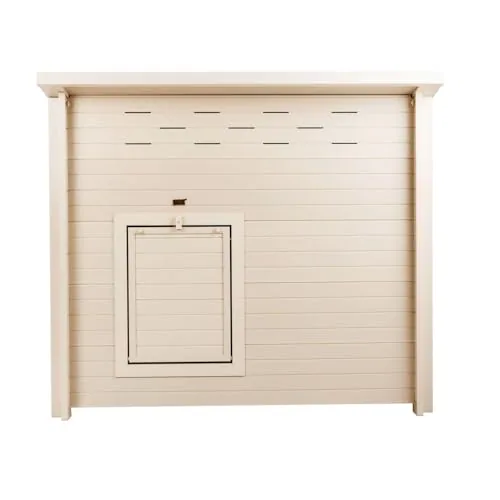
New Age Pet ECOFLEX Fontana Jumbo Chicken Coop
- Maker says
- 4–6 chickens
- Material
- ECOFLEX recycled polymer and wood fiber
- Nest boxes
- Side nesting box with hinged lid
Best for Small flocks wanting a non-wood coop
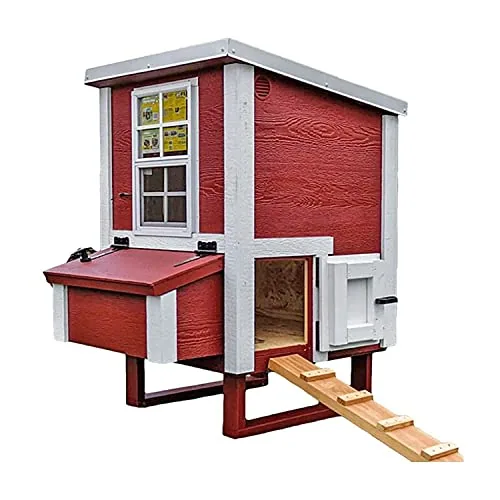
OverEZ Small Chicken Coop, Up to 5 Chickens
- Maker says
- Up to 5 chickens
- Material
- Wood panels
- Nest boxes
- Yes
Best for A first small flock
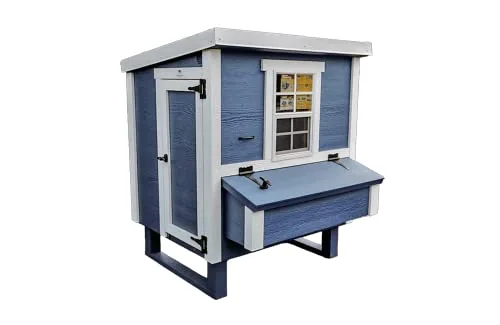
OverEZ Medium Chicken Coop, Up to 10 Chickens
- Maker says
- Up to 10 chickens
- Material
- Wood, non-toxic paint
- Nest boxes
- 3
Best for Growing backyard flocks
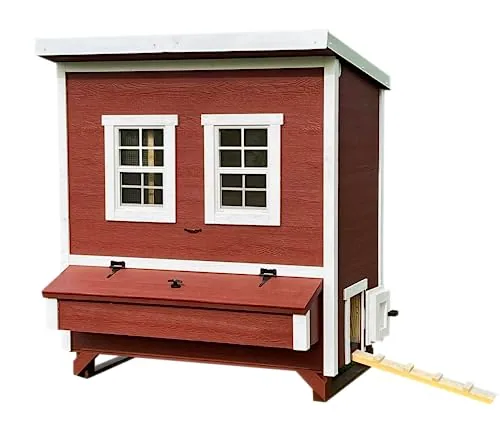
OverEZ Walk-in Chicken Coop, Up to 18 Chickens
- Maker says
- Up to 18 chickens
- Material
- Wood, metal roof
- Nest boxes
- 5
Best for Keepers who want to stand inside
How big should a chicken run be?
Penn State gives 8 sq ft of outdoor run per laying hen, 10 per large chicken and 4 per bantam, against 10 per bird in the 4 + 10 rule. For four standard hens that is 32–40 sq ft: roughly a 4 × 8 ft or 5 × 8 ft run. Ducks need far more (Penn State: 15 sq ft each).
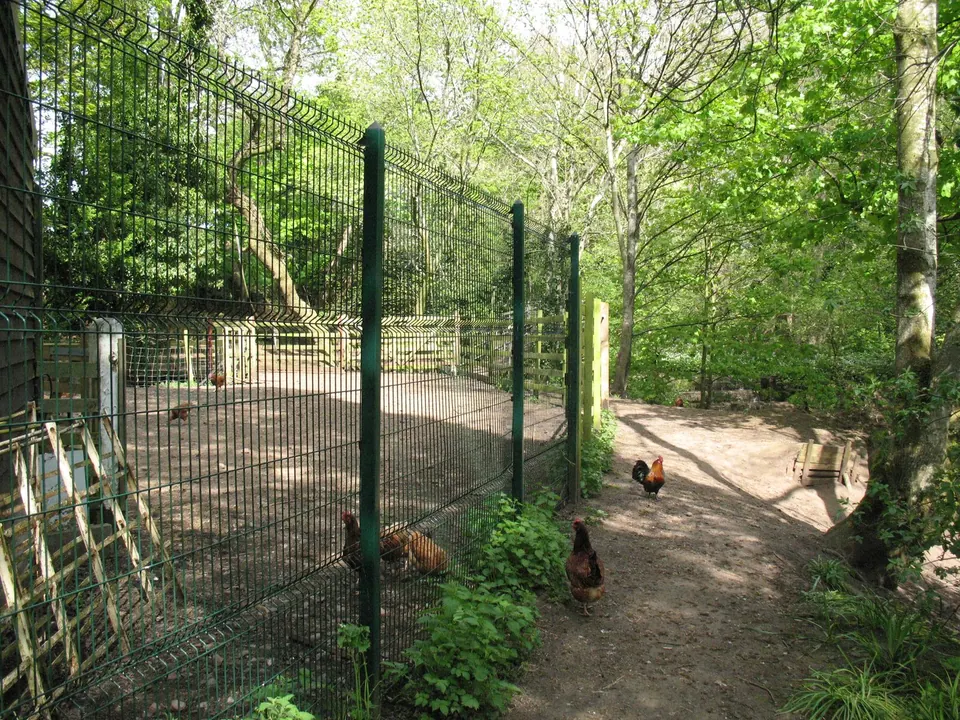
Cover the run against hawks and owls, and protect the bottom edge from diggers: Penn State recommends burying fence wire at least 12 in deep and bending it outward about 6 in. More in how to protect chickens from predators and the runs and fencing hub.
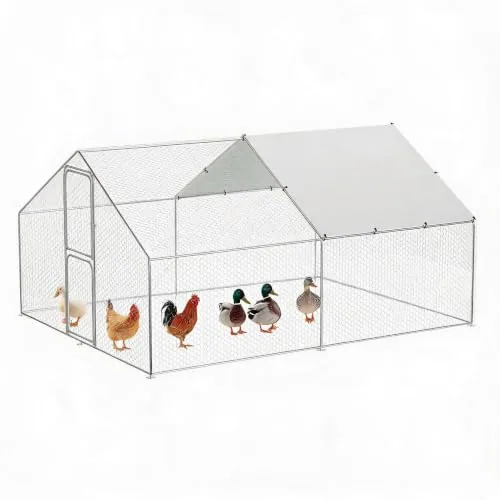
Garvee 9.8x13.1 ft Walk-in Metal Chicken Run
- Size
- 9.8 x 13.1 ft
- Height
- 6.6 ft
- Electric
- No
Best for Adding run space to an existing coop
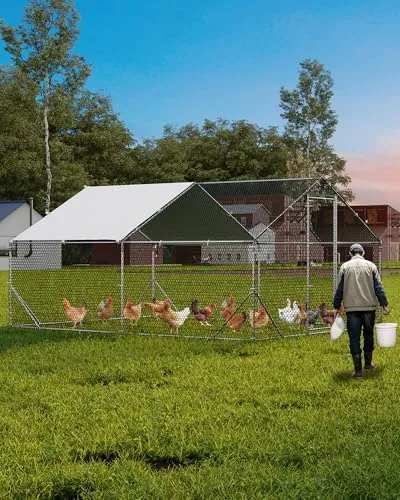
GarveeLife Walk-in Metal Chicken Run 13x9.8 ft
- Size
- 13.12 x 9.84 ft
- Height
- 6.56 ft
- Electric
- No
Best for Extending a wooden coop
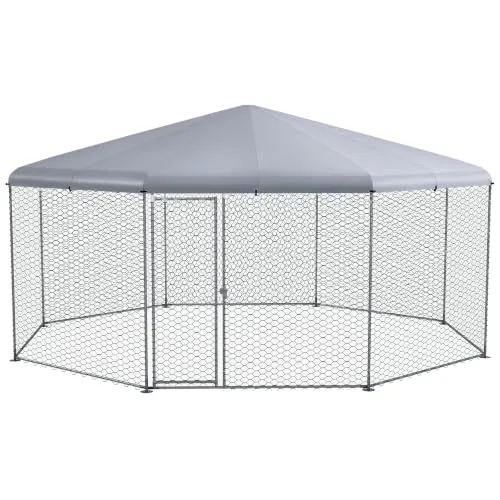
PawHut 17x15.7 ft Walk-in Metal Chicken Run
- Size
- 17.1 x 15.7 ft
- Height
- 9 ft
- Electric
- No
Best for Large covered runs
How much roost and nest-box space do chickens need?
Roosts and nests
| Item | Penn State | UMN |
|---|---|---|
| Roost length per bird | 6 in standard, 4 in bantam | 9 in per chicken (cold weather) |
| Roost height | 18–24 in off the floor (bantams 12–18 in), never above 4 ft; roosts 1 ft apart | At least 12 in above the floor |
| Roost material | Away from nest boxes | 2 × 4 or 2 × 2 wood; avoid metal and plastic |
| Nest boxes | 2 for the first 4 hens, +1 per 4 more; at least 12 × 12 in | 1 per 4–5 hens |
| Nest placement | At least 2 ft off the ground and 4 ft from roosts; dim spot | Not specified |
Source: Penn State Extension, Small-Scale Poultry Housing; UMN Extension
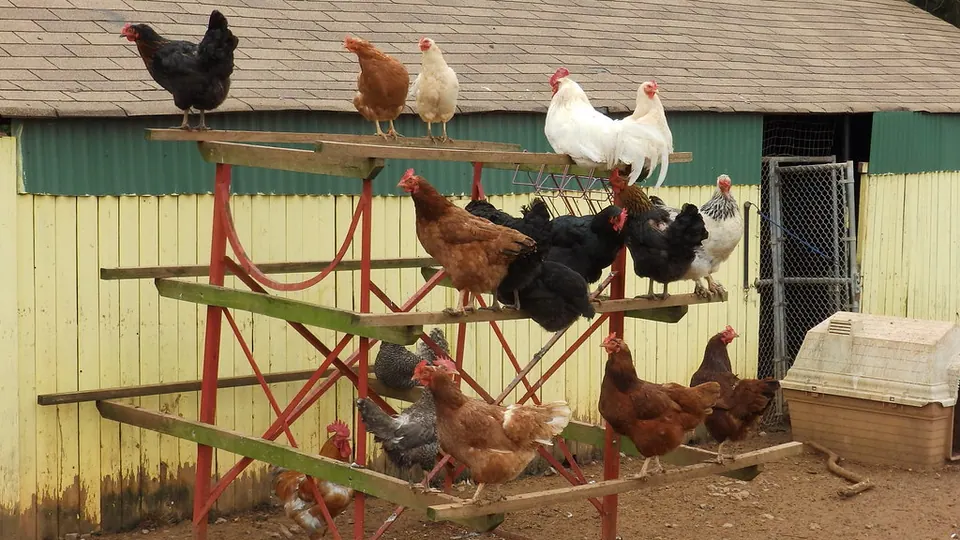
Roosts set higher than the nest boxes discourage hens from sleeping (and pooping) in the nests. If your coop's nests are too few, add-on boxes mount on the wall.
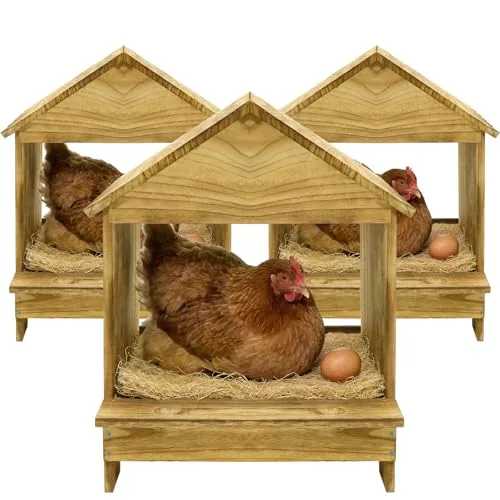
TRINFREE Farmhouse Wooden Nesting Boxes, 3-Pack
- Maker says
- 4–5 hens per compartment
- Material
- Carbonized solid wood
- Nest boxes
- 3
Best for Small backyard flocks
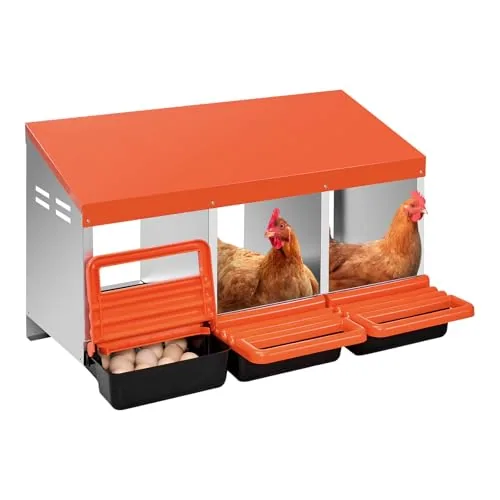
VEVOR 3-Compartment Roll-Out Nesting Box
- Maker says
- Up to 5 hens per box
- Material
- Galvanized steel, plastic
- Nest boxes
- 3, roll-out with lids
Best for Clean-egg collection
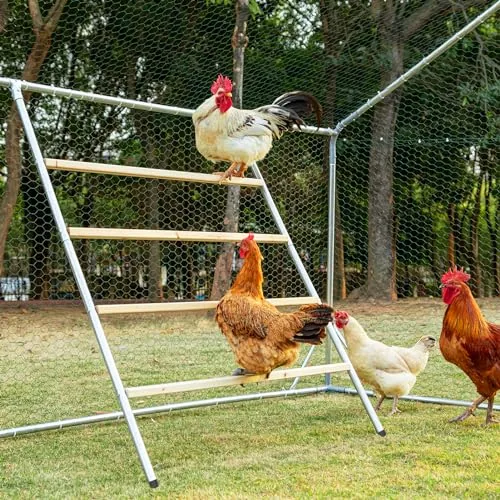
PETSFIT Square Roosting Perch 55x40, 4-Tier
- Maker says
- 8–10 chickens
- Material
- Solid fir and galvanized iron pipe
- Dimensions
- 55 x 40 in
Best for Adding roost space to a coop
Does coop height matter?
Floor area sets capacity, but height affects comfort and cleaning. Penn State keeps roosts no higher than 4 ft so heavy birds do not injure themselves jumping down, and you need enough headroom above the roosts for air to move. Ventilation openings belong high on the walls, above the birds, so they vent moist air without a draft at roost level; see chicken coop ventilation.
For you, a walk-in coop (OverEZ lists about 6 ft of interior clearance for its walk-in model) is far easier to clean than a coop you reach into. If you have back trouble or plan more than 6–8 birds, a walk-in is worth the footprint.
Coop-sizing mistakes to avoid
- Using overall dimensions. They include the run.
- Taking the listed hen count as fact. Recount by floor area.
- Sizing for bantams and buying large breeds. Penn State gives large chickens 2 sq ft inside and 10 in the run.
- Forgetting winter. Birds that stay inside on snowy days need UMN's 3–5 sq ft, not the minimum.
- Too few roost inches. 9 in per bird in cold weather (UMN) adds up fast.
- Ignoring local rules. Some towns set coop setbacks from property lines and size limits for sheds; check your city code and HOA before you build or buy. See backyard chicken laws.
Still deciding on numbers? Read how many chickens should I get? or browse coops in the coops and small backyard hubs.
Plan on at least 3 sq ft of inside floor per standard hen (UMN's low end), never less than Penn State's 1.5 sq ft minimum, and 8–10 sq ft of covered run per bird. Measure the house floor, not the overall size, and let that number, not the listing, decide how many hens you keep.