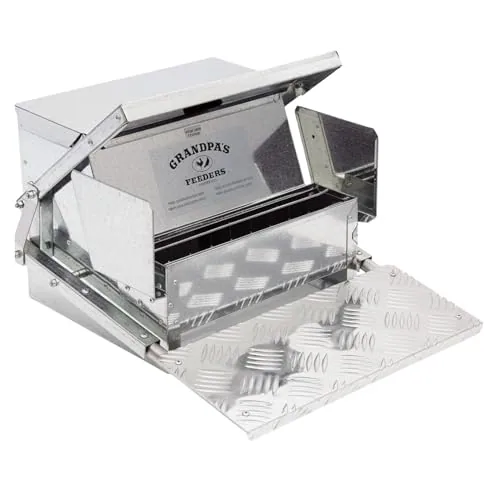
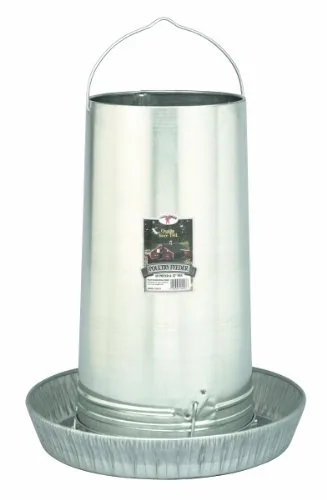
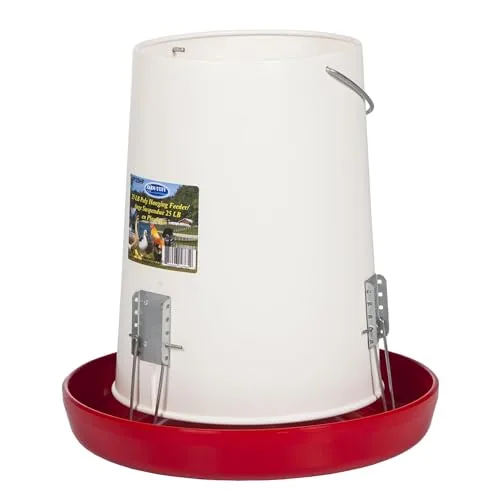
- Treadle vs hanging feeder: a treadle feeder keeps its feed covered until a hen steps on it, which is designed to keep rodents and wild birds out; a hanging feeder is always open but cheaper and simpler.
- Capacities overlap: the treadles here are listed at 12–40 lb and the hanging feeders at 6.6–40 lb.
- At about ¼ lb of feed per hen per day (extension figure), a 20 lb feeder lasts six hens about 13 days.
- Hanging feeders suit chicks, bantams and mixed flocks; treadles suit adult hens where rats, mice or sparrows are a problem.
Treadle vs hanging feeder is the main choice once your chicks move to the coop. A hanging feeder is a tube or cone of feed over a round pan, hung so the lip sits at the birds’ back height. A treadle feeder is a lidded box: when a hen steps on the plate, the lid lifts and she can eat; when she steps off, the lid closes. Both hold several days of feed, so the question is what else is eating it.
We compared the feeders by listed capacity, material and design, and worked out refill intervals using extension feed-intake figures. We did not run these feeders in a coop. Rodent and waste claims below are the makers’ claims, marked as such.
Treadle feeder
A lidded hopper that opens only when a hen steps on the plate, built to keep rodents and wild birds out
Browse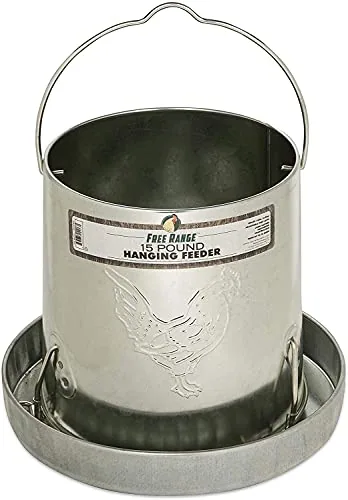
Hanging feeder
A gravity tube over a round pan, hung at back height; simple, cheap and easy for chicks to learn
BrowsePicks from each side
Treadle feeder
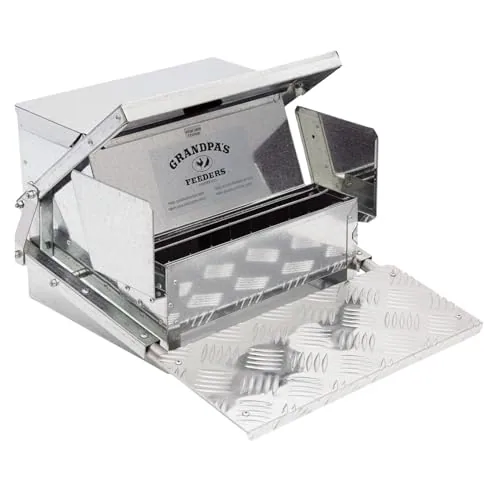
Grandpa's Feeders 20 lb Galvanized Treadle Feeder
- Type
- Treadle
- Capacity
- 20 lb
- Material
- Galvanized steel
Best for Small flocks with rodent pressure
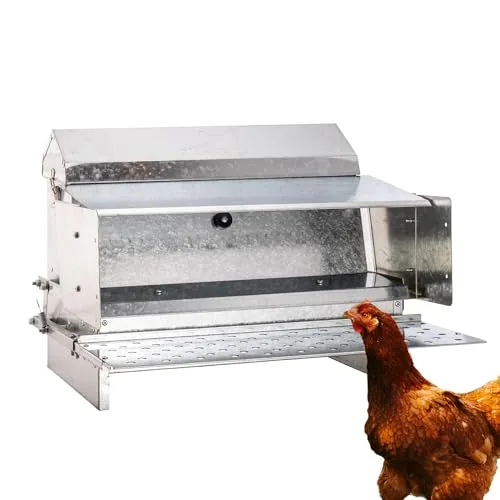
RentACoop Metal Treadle Feeder, 25 lb
- Type
- Treadle
- Capacity
- 25 lb
- Material
- Galvanized steel
Best for Small flocks with rodent pressure
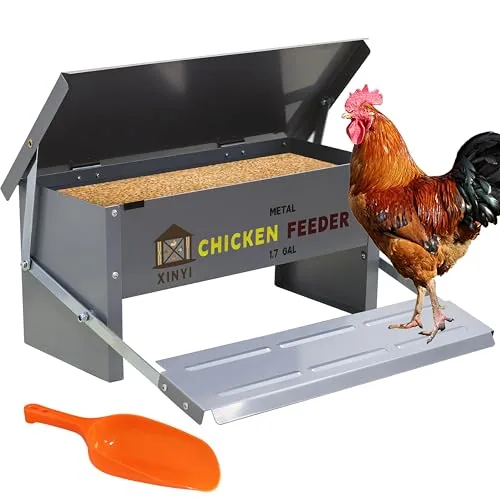
XINYI Metal Treadle Feeder, 12 lb
- Type
- Treadle
- Capacity
- 12 lb (1.7 gal)
- Material
- Galvanized steel
Best for Bantams and small flocks
Grandpa's Feeders 40 lb Galvanized Treadle Feeder
- Type
- Treadle
- Capacity
- 40 lb
- Material
- Galvanized steel
Best for Mid-size flocks with rodent pressure
Hanging feeder
Little Giant Galvanized Hanging Feeder, 40 lb
- Type
- Hanging
- Capacity
- 40 lb
- Material
- Galvanized steel
Best for Larger flocks needing fewer refills
FARM-TUFF Hanging Poultry Feeder, 25 lb
- Type
- Hanging
- Capacity
- 25 lb
- Material
- BPA-free polyethylene
Best for Larger flocks, fewer refills
Harris Farms Galvanized Hanging Feeder, 15 lb
- Type
- Hanging
- Capacity
- 15 lb
- Material
- Galvanized steel
Best for Simple durable feeding
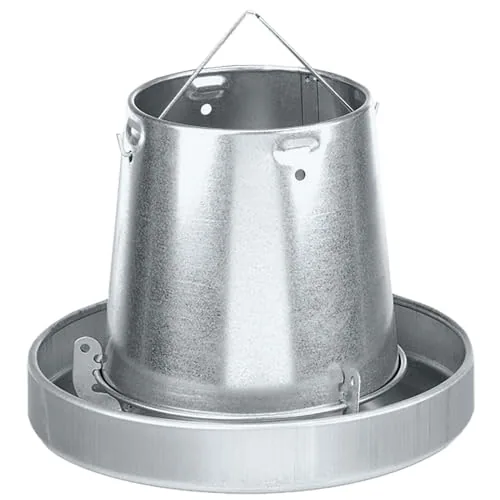
Premier 1 Galvanized Cone Feeder, 11 lb
- Type
- Hanging or free-standing cone
- Capacity
- 11 lb
- Material
- Galvanized metal
Best for General flock feeding
Treadle vs hanging feeder: the comparison table
How the two designs differ
| Treadle feeder | Hanging feeder | |
|---|---|---|
| Feed covered between meals | ✓ Lid closes when the hen steps off | ✗ Pan always open |
| Rodent and wild-bird access | ✓ Designed to block (maker claims) | ✗ Open to anything that reaches the pan |
| Training needed | ✗ Hens learn to step on the plate | ✓ None |
| Chicks and small bantams | ~ Some open at under 1 lb (XINYI lists 0.88 lb) | ✓ Lower the feeder as needed |
| Feed flicking | ~ Anti-flick grill on Grandpa’s | ~ Flow settings on Farm-Tuff (5 levels) |
| Material in our catalogue | Galvanized steel | Galvanized steel, stainless or plastic |
| Listed capacity | 12–40 lb (more with extensions) | 6.6–40 lb |
Source: Product listings
Listed specs
| Product | Capacity | Type | Material | Flock |
|---|---|---|---|---|
| Grandpa's Feeders 20 lb Galvanized Treadle Feeder | 20 lb | Treadle | Galvanized steel | 6 chickens up to 10 days |
| Grandpa's Feeders 40 lb Galvanized Treadle Feeder | 40 lb | Treadle | Galvanized steel | 6-12 chickens up to 10 days |
| RentACoop Metal Treadle Feeder, 25 lb | 25 lb | Treadle | Galvanized steel | — |
| RentACoop Metal Treadle Feeder, 40 lb | 40 lb | Treadle | Galvanized steel | — |
| XINYI Metal Treadle Feeder, 12 lb | 12 lb (1.7 gal) | Treadle | Galvanized steel | — |
| Little Giant Galvanized Hanging Feeder, 40 lb | 40 lb | Hanging | Galvanized steel | — |
| FARM-TUFF Hanging Poultry Feeder, 25 lb | 25 lb | Hanging | BPA-free polyethylene | — |
| Harris Farms Galvanized Hanging Feeder, 15 lb | 15 lb | Hanging | Galvanized steel | — |
| Premier 1 Galvanized Cone Feeder, 11 lb | 11 lb | Hanging or free-standing cone | Galvanized metal | Up to 44 birds (maker) |
| Plexon Stainless Hanging Feeder, 6.6 lb | 6.6 lb | Hanging | Stainless steel | — |
Specs as listed by the maker or seller; check the listing before you buy.
How long will a feeder last between refills?
Extension services give similar feed figures for laying hens: about ¼ lb a day (Alabama), ¼–⅓ lb (Mississippi State), or roughly 3 lb a week for a 6 lb hen (University of Minnesota). UMN adds that hens may eat up to 25% more in cold weather. The chart applies ¼ lb a day to a flock of six hens.
Days of feed for 6 hens at ¼ lb per hen per day
Listed capacity ÷ 1.5 lb a day, rounded down; cold weather shortens this
Grandpa’s Feeders rates its 20 lb model for six chickens for up to 10 days, a little less than the math above, which allows for spillage and bigger appetites. Feed also goes stale and can mold if it sits too long or gets damp, so a bigger feeder is not always better for a small flock. Buy a size that empties within a couple of weeks, and use the feed and egg cost calculator to plan bag sizes for your flock.
Do treadle feeders really stop rats and wild birds?
That is what they are built for. RentACoop says its feeder opens only when a bird steps on the treadle and offers an optional overnight step lock; Grandpa’s says its treadle is designed to keep rodents out. Light animals such as mice and sparrows are meant to be too light to open the lid, though the exact trigger weight varies by model: XINYI says birds over about 0.88 lb can open its small feeder. A rat heavy enough to press the plate could, in principle, open some designs, so treat a treadle as one layer of rodent control.
Keeping wild birds out of the feed matters for more than waste. USDA APHIS advises backyard flock owners to keep wild birds away from feed and water to reduce the risk of bird flu. A closed feeder, a covered run and cleaning up spilled feed all help.
Setting up either feeder correctly
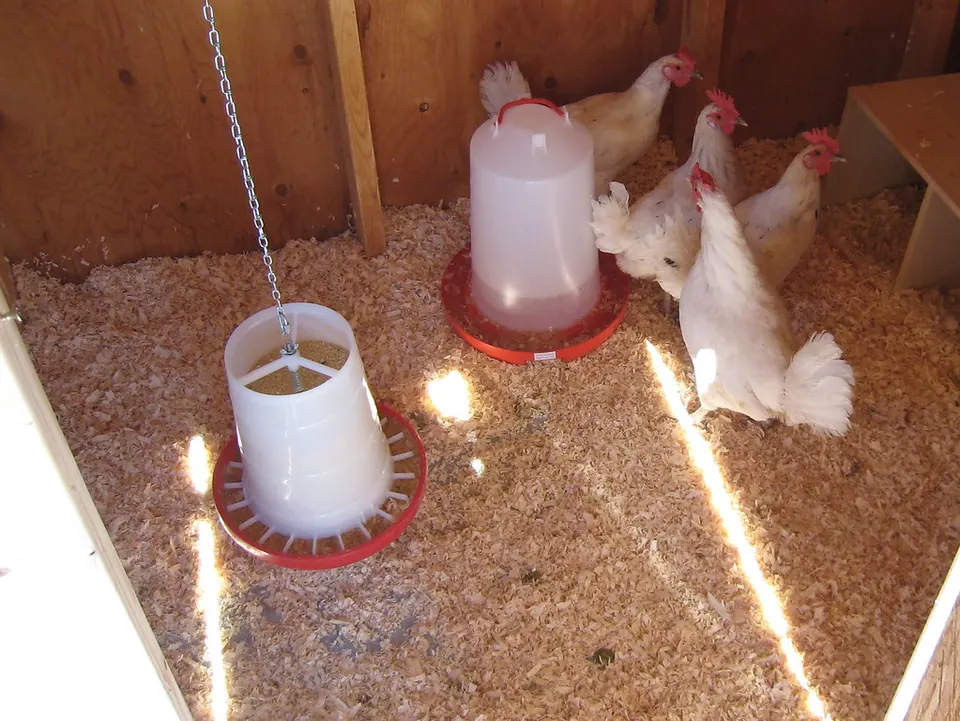
Penn State Extension gives two simple rules for laying flocks: allow about 3 inches of feeder space per bird, and set the feeder lip level with the birds’ backs, which cuts waste from birds raking feed out. Trough feeders should be filled only one-third to one-half full for the same reason.
- Place it on a level, dry base
Set a treadle feeder on pavers or a board so the plate moves freely. Hang a tube feeder from a chain so you can adjust the height.
- Set the height
Hang the pan lip at back height (Penn State) and raise it as birds grow. For a treadle, the opening should sit at about the same height.
- Train hens on a treadle
Follow the maker’s training instructions. A simple approach is to prop the lid open for the first days so hens learn where the food is, then let it close. Check every bird is eating before removing other feeders.
- Keep feed dry and fresh
Close lids, keep the feeder under cover, and empty and clean it if feed gets wet or clumps. Add a weekly feeder check to the flock checklist.
Who should choose a treadle, and who a hanging feeder?
A treadle feeder suits you if you…
- see rats, mice or sparrows at the feed;
- keep adult standard hens heavy enough to work the plate;
- want a steel box that stays covered in rain (latched or weatherproof lids on RentACoop, Grandpa’s and XINYI);
- want to expand later: RentACoop sells 15 lb extensions for its 25 and 40 lb models.
A hanging feeder suits you if you…
- are moving chicks or young pullets out of the brooder;
- keep bantams, quail or ducks alongside chickens (Premier 1 lists its cone feeder as waterfowl friendly);
- keep the coop and run rodent-tight already;
- want the lowest-cost, simplest option.
Mistakes to avoid
- Leaving a hanging feeder in the open run. An open pan in the run feeds wild birds and rodents too; move it inside the coop.
- Removing the old feeder too soon. Make sure every hen uses the treadle before you take the hanging feeder away.
- Setting the feeder too low. Birds scratch feed out of a low pan; keep the lip at back height.
- Overfilling a big feeder for a small flock. Old feed can go stale; size the feeder to your flock.
- Mixing treats into the feeder. Treats crowd out complete feed. See best layer feed for the base diet.
Want more models from more brands? Browse the feeders and waterers category or the first flock hub.
If rodents or wild birds are eating your feed, a treadle feeder is worth it: the covered hopper is designed to open only for hens, and the 20–25 lb sizes from Grandpa’s, RentACoop and XINYI suit a typical backyard flock. If your coop is already rodent-tight, you keep chicks or bantams, or you want the simplest setup, a hanging feeder such as the Little Giant 40 lb or Farm-Tuff 25 lb does the job, hung at back height and kept indoors.