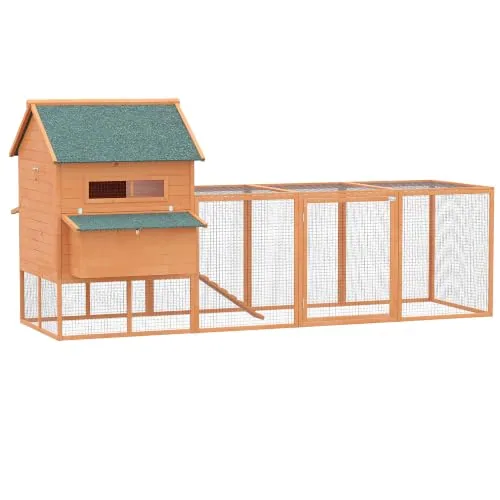
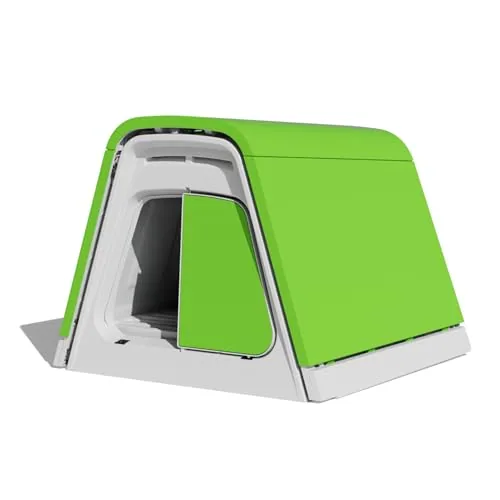
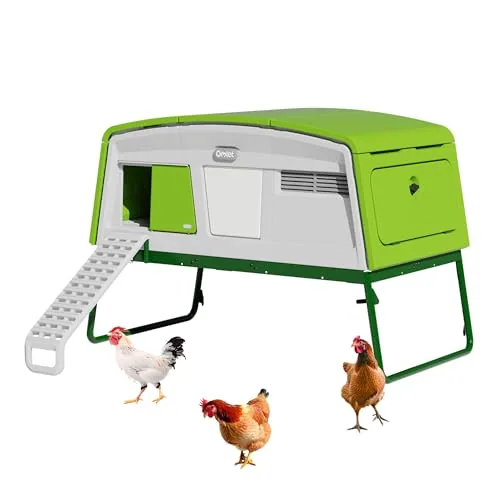
- Wood vs plastic chicken coop: wood is cheaper to start and easy to modify; plastic and composite coops clean faster and list longer warranties (10 years on the Omlet Eglu Pro and the New Age Pet ECOFLEX).
- Material matters less than floor space. Recheck every listed hen count: the PawHut 39" coop is listed for 2–4 chickens, but its 4 sq ft house fits about 2 standard hens by the Penn State minimum.
- Ventilation, predator-resistant latches and a run matter in both materials.
- Buy Eglu coops from official Omlet listings only: imitation Eglu-style coops exist.
Wood vs plastic chicken coop is a question about upkeep as much as looks. Wooden coops are the classic choice and range from flat-pack fir kits to made-in-USA painted panel coops. Plastic coops, led by Omlet’s twin-wall Eglu line, and composite coops made from recycled polymer and wood fiber promise surfaces you can scrape and hose down, with no paint to renew.
This comparison uses the materials, dimensions, hen counts and warranties stated on each listing, and checks the hen counts against published space norms from Penn State Extension and the University of Minnesota. We did not house birds in these coops. When a listing gives a hen count but no floor size, we say so instead of guessing.
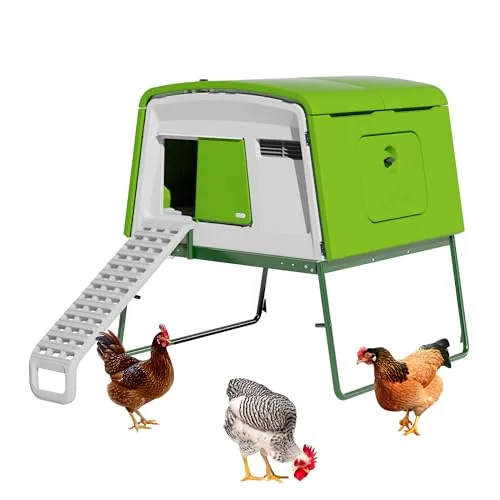
Plastic and composite coops
Twin-wall plastic Eglus and recycled-polymer coops: hose-clean surfaces, long listed warranties
BrowsePicks from each side
Wood coops
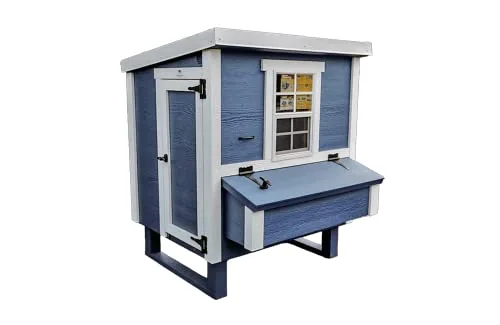
OverEZ Medium Chicken Coop, Up to 10 Chickens
- Maker says
- Up to 10 chickens
- Material
- Wood, non-toxic paint
- Nest boxes
- 3
Best for Growing backyard flocks
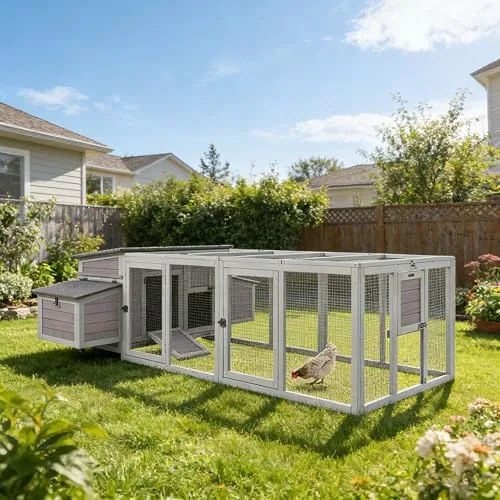
Aivituvin AIR45 Chicken Coop, Two Nest Boxes
- Maker says
- 4–6 chickens
- Material
- Fir wood, steel wire
- Nest boxes
- 2
Best for Small flocks starting out
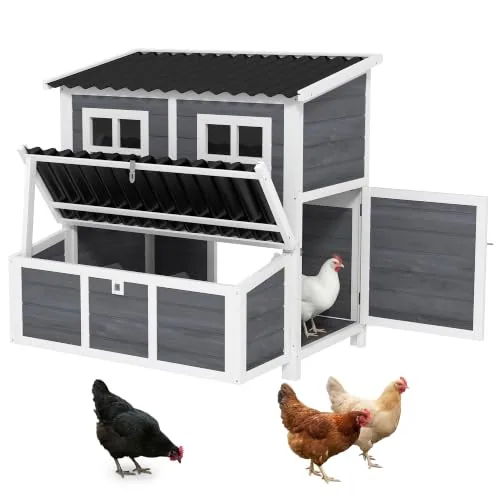
PawHut 39" Wooden Chicken Coop, 2–4 Chickens
- Maker says
- 2–4 chickens
- Floor area
- Main house 4 sq ft; nest box 2 sq ft
- Material
- Fir wood
Best for Two hens in a small yard
PawHut 137" Chicken Coop with Run, 8–10 Chickens
- Maker says
- 8–10 chickens
- Material
- Solid fir, anti-UV roof
- Nest boxes
- 2 triple boxes
Best for Mid-size flocks
Plastic and composite coops
Omlet Eglu Go Chicken Coop (Coop Only)
- Maker says
- Up to 3 large hens or 4 bantams
- Material
- Twin-wall insulated plastic
- Nest boxes
- Nesting area
Best for Starter flock of three
Omlet Eglu Pro Large Chicken Coop (Coop Only)
- Maker says
- Up to 10 large hens or 15 bantams
- Material
- Twin-wall insulated plastic
- Nest boxes
- Slide-out nest box tray
Best for Larger flocks wanting plastic
Omlet Eglu Cube Large Chicken Coop (Coop Only)
- Maker says
- Not stated in listing
- Material
- Insulated plastic
- Dimensions
- 39.4 x 37 x 25.6 in (coop, as listed)
Best for Small flocks wanting low upkeep
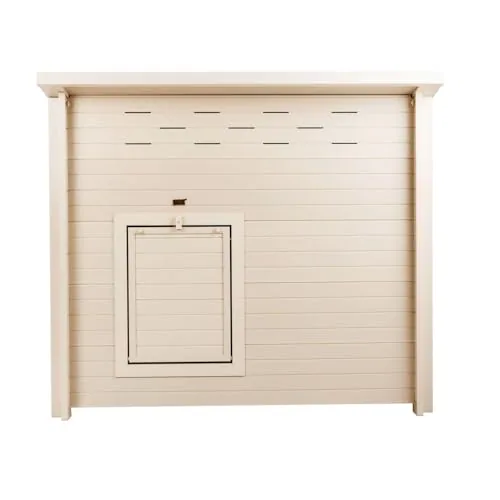
New Age Pet ECOFLEX Fontana Jumbo Chicken Coop
- Maker says
- 4–6 chickens
- Material
- ECOFLEX recycled polymer and wood fiber
- Nest boxes
- Side nesting box with hinged lid
Best for Small flocks wanting a non-wood coop
Wood vs plastic chicken coop: side by side
Material differences
| Wood coops | Plastic and composite coops | |
|---|---|---|
| Starting cost | ✓ Wide range, many budget kits | ✗ Usually higher |
| Cleaning | ~ Scrape and scrub; seams and bare wood hold dirt | ✓ Smooth panels, hose clean (maker claims) |
| Upkeep | ✗ Paint or seal; check for rot | ✓ No paint (Omlet lists zero maintenance) |
| Insulation | ~ Depends on wall thickness | ✓ Twin-wall on Eglu Go and Pro, per Omlet |
| Easy to modify | ✓ Add vents, roosts, a door | ✗ Use the maker’s accessories |
| Listed warranty | ~ Often not listed | ✓ 10 years (Eglu Pro, ECOFLEX) |
| Weight to move | ~ Heavy unless on wheels | ~ Light shell; runs often sold separately |
| Knockoff risk | ~ Low | ✗ Imitation Eglu coops exist |
Source: Product listings; Taste of Home (imitation Eglu warning)
Listed specs, wood and plastic coops
| Product | Material | Dimensions | Maker says | Nest boxes |
|---|---|---|---|---|
| OverEZ Medium Chicken Coop, Up to 10 Chickens | Wood, non-toxic paint | 50.3 x 52.5 x 62.3 in | Up to 10 chickens | 3 |
| Aivituvin AIR45 Chicken Coop, Two Nest Boxes | Fir wood, steel wire | 103 x 67 x 28 in (as listed); run 79 in long | 4–6 chickens | 2 |
| PawHut 39" Wooden Chicken Coop, 2–4 Chickens | Fir wood | 39.4 x 33.9 x 39.4 in | 2–4 chickens | 3 compartments |
| PawHut 137" Chicken Coop with Run, 8–10 Chickens | Solid fir, anti-UV roof | 136.5 x 63 x 59 in | 8–10 chickens | 2 triple boxes |
| Omlet Eglu Go Chicken Coop (Coop Only) | Twin-wall insulated plastic | 65 x 37 x 46 in (as listed) | Up to 3 large hens or 4 bantams | Nesting area |
| Omlet Eglu Cube Large Chicken Coop (Coop Only) | Insulated plastic | 39.4 x 37 x 25.6 in (coop, as listed) | Not stated in listing | — |
| Omlet Eglu Pro Large Chicken Coop (Coop Only) | Twin-wall insulated plastic | 65 x 37 x 46 in (as listed) | Up to 10 large hens or 15 bantams | Slide-out nest box tray |
| New Age Pet ECOFLEX Fontana Jumbo Chicken Coop | ECOFLEX recycled polymer and wood fiber | 54.2 x 46.4 x 54.1 in overall; interior ~41 x 36.8 x 35 in | 4–6 chickens | Side nesting box with hinged lid |
Specs as listed by the maker or seller; check the listing before you buy.
How many hens actually fit? Check the floor, not the box
Coop listings often give a generous hen count. Penn State Extension’s minimum is 1.5 sq ft per laying hen inside the house plus 8 sq ft in the run; University of Minnesota Extension recommends 3–5 sq ft of indoor space per bird; a common hobby rule is 4 sq ft inside and 10 in the run. The table below shows all three by bird type.
Space per bird, square feet: inside the coop / in the run
| Birds | Penn State | UMN | 4 + 10 rule |
|---|---|---|---|
| Standard laying hens | 1.5 / 8 | 3–5 / — | 4 / 10 |
| Large breeds | 2 / 10 | 3–5 / — | 4 / 10 |
| Bantams | 1 / 4 | 3–5 / — | — |
| Ducks | 3 / 15 | — | — |
| Geese | 6 / 18 | — | — |
| Quail | 1 / 4 | — | — |
Sources: Penn State Extension, Small-Scale Poultry Housing, Table 1 (Minimum Space Requirements for Poultry); University of Minnesota Extension, Raising chickens for eggs (“a minimum of 3 to 5 square feet of indoor space per bird”); Widely repeated hobby guideline (4 sq ft inside, 10 sq ft in the run per standard chicken), e.g. GRIT, Chicken Coop Space Requirements. — = not given by that source.
Only two coops in this comparison list an inside floor size, so only those two can be recounted honestly. The chart shows the listed hen count next to each norm, rounded down.
Listed hens vs space norms, standard laying hens
PawHut 39" (4 sq ft house) and New Age Pet ECOFLEX Jumbo (interior about 41 × 36.8 in, 10.5 sq ft)
Realistic capacity
Maker says 2–4 chickens. By the Penn State Extension minimum norm (1.5 sq ft per laying hen inside) this coop fits ≈ 2 standard hens.
| Norm (source) | Inside, sq ft per hen | Fits in the coop |
|---|---|---|
| Penn State Extension minimum | 1.5 | 2 |
| University of Minnesota Extension | 3–5 | 0–1 |
| Common 4 + 10 rule of thumb | 4 | 1 |
Coop floor 4.0 sq ft (listing: Main house 4 sq ft; nest box 2 sq ft). Counts are rounded down, for standard-size laying hens; bantams need less (Penn State: 1 sq ft inside). Nest boxes and roosts are not counted. These are published planning figures, not a test of this coop: measure the inside floor before you add birds. Check your own flock in the coop size calculator.
Realistic capacity
Maker says 4–6 chickens. By the Penn State Extension minimum norm (1.5 sq ft per laying hen inside) this coop fits ≈ 6 standard hens.
| Norm (source) | Inside, sq ft per hen | Fits in the coop |
|---|---|---|
| Penn State Extension minimum | 1.5 | 6 |
| University of Minnesota Extension | 3–5 | 2–3 |
| Common 4 + 10 rule of thumb | 4 | 2 |
Coop floor 10 sq ft (listing: interior ~41 x 36.8 x 35 in). Counts are rounded down, for standard-size laying hens; bantams need less (Penn State: 1 sq ft inside). Nest boxes and roosts are not counted. These are published planning figures, not a test of this coop: measure the inside floor before you add birds. Check your own flock in the coop size calculator.
Omlet lists the Eglu Go for up to 3 large hens or 4 bantams and the Eglu Pro for up to 10 large hens or 15 bantams; the Eglu Cube listing gives no hen count. The listed dimensions for the Eglu Go and Pro (65 × 37 × 46 in) look like overall or packaging figures, and Omlet’s listings don’t give the inside floor, so we can’t recount them. OverEZ lists the Medium for up to 10 chickens at 50.3 × 52.5 × 62.3 in overall. Ask the maker for the inside floor, or measure it, and run it through the coop size calculator.
Cleaning, mites and everyday upkeep
Plastic’s strongest selling point is cleaning. Omlet describes the Eglu Pro’s slide-out nest box tray and says the coop needs zero maintenance and has fully replaceable parts. New Age Pet lists its ECOFLEX material as resistant to moisture, odor and scratches. Wood coops vary: many fir kits list a pull-out tray (the Aivituvin AIR45 lists a lockable metal slide-out tray), but bare wood, joints and roof seams take more scrubbing.
Wood’s advantage is flexibility. You can add a vent, raise a roost or cut a pop hole for an automatic door. Paint or seal exterior wood, check the roof each fall and replace soft boards early. OverEZ lists non-toxic paint on its panel coops.
With either material, a regular routine does more than the coop’s marketing. Our coop cleaning guide walks through a deep clean, and the flock care checklist keeps weekly jobs on track. For mite or lice treatments, use any product only per its label and follow the label’s egg-withdrawal time.
Heat, cold and ventilation
Omlet says the twin-wall insulation on the Eglu Go and Pro keeps hens warm in winter and cool in summer, and the Eglu Pro adds adjustable vents. Wood has some natural insulation, more in thick panels than in thin fir kits.
In both materials, moisture is the winter enemy. University of Minnesota Extension stresses ventilation in cold weather so damp air from breathing and droppings can escape; a sealed coop raises the risk of frostbite. Look for vents above roost height in any coop, and read our ventilation guide. Penn State gives roost space of about 6 in per standard bird and 18–24 in above the floor; UMN suggests 9 in per bird in cold weather.
Predator protection in wood and plastic
Omlet describes the Eglu Pro as predator proof, and many wood kits list latches and wire runs. Raccoons can open simple hook latches, and light chicken wire keeps chickens in more than it keeps predators out. Whatever the material, add two-step latches, cover vents with hardware cloth and lock the coop at night or fit an automatic door. Our predator guide covers the details.

Who should choose wood, and who plastic?
Choose wood if you…
- want the widest choice of sizes, from tractors to walk-ins (the OverEZ Walk-in lists 6 ft of interior clearance);
- like to modify, insulate or paint your coop;
- want a starter kit for 2–4 hens and will recheck the floor space;
- plan a larger flock: OverEZ lists models from up to 5 to up to 30 chickens.
Choose plastic or composite if you…
- want fast cleaning and no repainting;
- value a long listed warranty (10 years on the Eglu Pro and the ECOFLEX Jumbo);
- keep a small flock in a suburban yard and like a modern look;
- will buy a run separately (the Eglu Go, Cube and Pro listings are coop only).
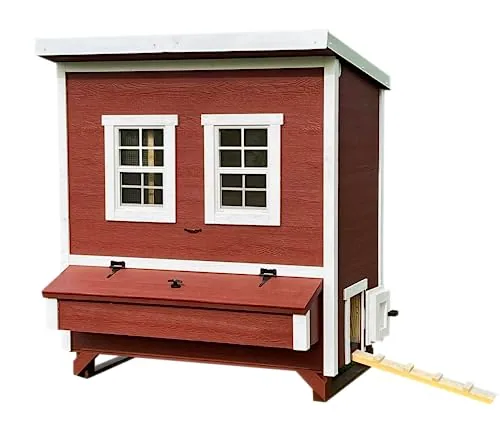
OverEZ Walk-in Chicken Coop, Up to 18 Chickens
- Maker says
- Up to 18 chickens
- Material
- Wood, metal roof
- Nest boxes
- 5
Best for Keepers who want to stand inside
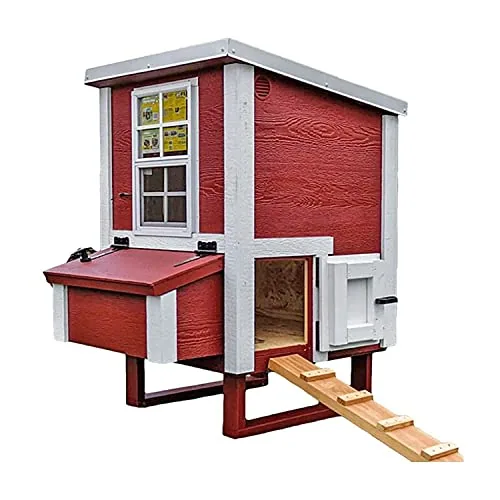
OverEZ Small Chicken Coop, Up to 5 Chickens
- Maker says
- Up to 5 chickens
- Material
- Wood panels
- Nest boxes
- Yes
Best for A first small flock
Mistakes to avoid when buying a coop
- Trusting the hen count. Recount with the inside floor and Penn State or UMN norms.
- Using overall dimensions. They include the run and roof overhang, not the house floor.
- Forgetting the run. Penn State gives 8 sq ft of run per laying hen; Eglu listings are coop only.
- Sealing up for winter. Keep vents open above the roosts.
- Buying an imitation Eglu. Look-alike plastic coops are not Omlet products and may not fit Omlet runs or doors.
Check local ordinances on hen numbers and setbacks before you buy; see our backyard chicken laws guide. More options in best chicken coops and the small backyard hub.
Wood wins on choice, size range and starting cost, and you can adapt it as your flock grows; plan on sealing, painting and closer cleaning. Plastic and composite coops win on cleaning and listed warranties, at a higher starting cost and with runs often sold separately. In both, the inside floor area decides how many hens fit: recount every listing with the Penn State or UMN norms, and buy Eglus only from official Omlet listings.