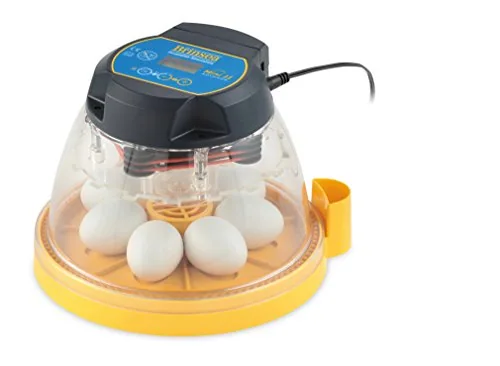
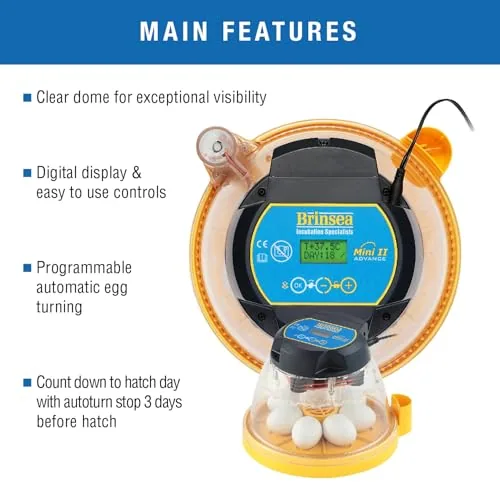

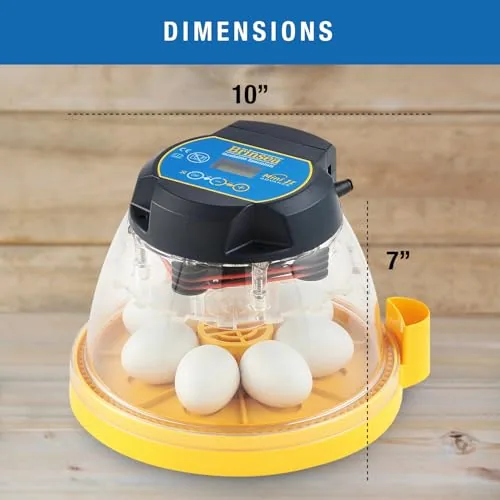
- Holds 7 hen or duck eggs, or 12 quail or pheasant eggs with the small egg disc (sold separately), per Brinsea.
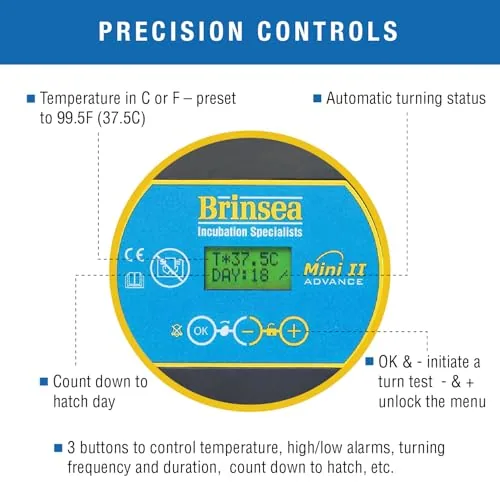
- Automatic turning that stops 2 days before the hatch-day countdown ends.
- High and low temperature alarms plus a room-temperature alarm.
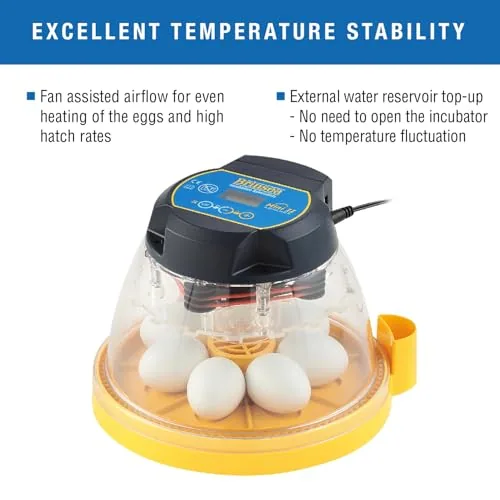
- Manual humidity: fill one or both halves of the water pot from an external fill point.
- Brinsea asks for a room of 68–77°F that never drops below 63°F.
This Brinsea Mini II Advance review covers model USAB16C, the seven-egg version of Brinsea’s clear-dome incubator. It is the machine many teachers and first-time hatchers start with, partly because it is hard to get the basics wrong: the menu holds temperature, turning, alarm and countdown settings, and keeps them through a power cut.
Everything here comes from Brinsea’s US manual and product page, the listing and extension incubation guidance. We have not hatched eggs in one. Where Brinsea gives a number, we quote it; where it does not, we say so.
Who it’s for, and who should skip it
- Want a first hatch of up to seven chicken eggs with as few things to remember as possible
- Like alarms: high and low incubator temperature, plus a room-temperature warning
- Want to add water through an external fill point without lifting the dome
- Run a classroom or homeschool hatch and value a clear dome for watching pipping
- Hatch quail or bantams occasionally and will buy the 12-egg small egg disc
- Want to set more than seven standard eggs at a time
- Need humidity controlled automatically (Brinsea points to the Mini II EX for that)
- Plan to run it in an unheated garage or shed where the room drops below 63°F
- Mostly hatch goose eggs, which are too big for the standard disc
Pros and cons
- Automatic turning with auto-stop tied to the day countdown
- Adjustable turn interval (15–180 minutes) and turn angle for different egg sizes
- High and low temperature alarms with adjustable margins, plus room-temperature alarms
- External water fill point, so you rarely need to lift the dome
- Settings are kept through a power cut, and a power-loss indicator shows it happened
- Three-year guarantee with registration, per Brinsea
- Small capacity: 7 standard eggs, or 12 small eggs with an extra disc
- Humidity is manual and depends on room conditions
- Needs a heated room: Brinsea says never below 63°F
- Parts must not go in the dishwasher or in water over 120°F
Specs
| Egg capacity | 7 chicken eggs; 12 small eggs with optional insert |
|---|---|
| Turning | Automatic with auto-stop |
| Humidity control | Manual, external water top-up |
| Fan | Forced-air (fan-assisted) |
| Display/alarms | Digital countdown; room-temp and high/low temp alarms |
As stated by the maker or seller; confirm on the listing before you buy.
What makes the Brinsea Mini II Advance different?
Most small incubators can hold a temperature. The Mini II Advance adds the pieces that prevent common beginner mistakes. You set a day countdown for each batch (21 for hens, 28 for ducks, per the manual), and in AUTO mode the turner rolls the eggs left and right until the countdown reaches 2, then stops by itself. A fan moves the air, so it is a forced-air incubator, and the temperature sensor is individually calibrated at the factory.
The alarms are configurable. By default, the high alarm trips 3.6°F above the setpoint and the low alarm 5.4°F below. The room alarm warns when the calculated room temperature stays too high or too low. Brinsea’s advice after any alarm is to candle the eggs a few times to check for losses.
Setting up the Mini II Advance
- Choose the room
Brinsea wants a heated room, ideally 68–77°F, never below 63°F, out of direct sunlight, on a level table and not on the floor.
- Assemble
Fit the water pot guard (it stops chicks drowning), place the egg disc ribbed side up and seat the top flush on the base. Use only the supplied power unit.
- Warm up and check
Run it for several hours until the temperature is stable. Brinsea suggests waiting at least an hour before changing the temperature, and warns that cheap thermometers may disagree with the calibrated display.
- Set the countdown and turning
Set DAYS to 21 for chicken eggs, turning mode to AUT. Brinsea’s example poultry settings use a 45-minute turn interval and a 7-second turn angle.
- Add water
For poultry, keep water in one half of the central pot from setting until 2 days before hatch, then fill both halves, using the external fill point.
- Set the eggs
Lay eggs flat with pointed ends toward the middle of the disc. Do not adjust the temperature for 24 hours while the eggs warm. Check water every 2 days or so.
Brinsea also says eggs keep best stored cool and damp for up to 14 days before setting. It advises discarding cracked or heavily soiled eggs instead of washing them, because washing removes the cuticle. Our day-by-day incubation guide walks through the full 21 days.
How does humidity work in the Mini II Advance?
This is the model’s main limit. Humidity comes from the central water pot, so you raise it by filling one or both halves. The manual is candid that this simple method makes no allowance for room conditions. For high-value eggs or poor results, it recommends weighing eggs and aiming for typical weight losses of about 13% for poultry and 14% for waterfowl. Its general guide is 40–50% RH for poultry during incubation and 65% or more at hatch. Brinsea’s separate humidity page gives 45–50% for chickens.
Incubation by species: forced-air settings, with the still-air offset
| Species | Days to hatch | Forced-air temp | Still-air temp | Wet-bulb, days 1 to lockdown → last 3 days | Relative humidity | Stop turning (day) |
|---|---|---|---|---|---|---|
| Chicken | 21 | 100°F (37.8°C) | 102–103°F | 85–87°F → 90°F | 45–50% → 65% or more | 18 |
| Duck (most breeds) | 28 | 100°F (37.8°C) | 102–103°F | 85–86°F → 90°F | 55–60% → 70% or more | 25 |
| Muscovy duck | 35–37 | 100°F (37.8°C) | 102–103°F | 85–86°F → 90°F | 58–60% → 65% or more | 31 |
| Coturnix quail | 17 | 100°F (37.8°C) | 102–103°F | 85–86°F → 90°F | 40–50% → 65% or more | 15 |
| Bobwhite quail | 23–24 | 100°F (37.8°C) | 102–103°F | 84–87°F → 90°F | 40–50% → 65% or more | 20 |
| Turkey | 28 | 99°F (37.2°C) | 101–102°F | 84–86°F → 90°F | 58–60% → 65% or more | 25 |
| Goose | 28–34 | 99°F (37.2°C) | 101–102°F | 86–88°F → 90°F | 58–60% → 65% or more | 25 |
| Guinea fowl | 28 | 100°F (37.8°C) | 102–103°F | 85–87°F → 90°F | 58–60% → 65% or more | 25 |
| Pheasant | 23–28 | 100°F (37.8°C) | 102–103°F | 86–88°F → 92°F | 58–60% → 65% or more | 21 |
| Peafowl | 28–30 | 99°F (37.2°C) | 101–102°F | 84–86°F → 90°F | 58–60% → 65% or more | 25 |
| Chukar partridge | 23–24 | 100°F (37.8°C) | 102–103°F | 81–83°F → 90°F | 58–60% → 65% or more | 20 |
Days, temperatures, wet-bulb and stop-turning days: Mississippi State University Extension, Important Incubation Factors. Still-air: add 2–3°F, measured at the top of the eggs (MSU). Relative humidity: Brinsea, Humidity during incubation for chickens, ducks and quail; other species show MSU's general 58–60%. Follow your incubator's manual first.
If you cannot get humidity high enough, Brinsea suggests adding water through the fill point or fitting evaporating card strips. During the hatch, it asks you to leave at least 6 hours between lid lifts, because humidity crashes when the top comes off.
Lockdown, hatching and cleanup
Two days before the hatch is due, the turner stops (in AUTO). Remove the egg disc, lay the eggs on the hatching mat and replace the top. Brinsea says to move hatchlings to a brooder once most have hatched, 12–48 hours after the first chick. Have the brooder warm before then. Our brooder temperature chart gives the Penn State schedule.
For cleanup, unplug the unit and wash the base and egg disc in Brinsea’s incubation disinfectant, then rinse. Wipe internal surfaces with a damp cloth and brush dust from the fan guard. Never immerse the top, never use a dishwasher and keep liquids under 120°F. Before storage, run it dry for 24 hours.
Brinsea Mini II Advance vs bigger incubators
Seven eggs leaves little room for infertile or early-dead eggs, so a batch can end with only a few chicks. That is ideal for a classroom demo or a backyard top-up. For a full flock start, a 20-plus-egg incubator often makes more sense. The Nurture Right 360 holds 22 chicken eggs with an auto-stop turner but no listed alarms, and the Maxi 24 EX adds automatic humidity. See Brinsea vs Nurture Right and best egg incubators, or start from the incubation and hatching at home or school hubs.
Planning a class project? Read hatching projects at school and home first, including what happens to the chicks after the hatch.
Alternatives worth a look
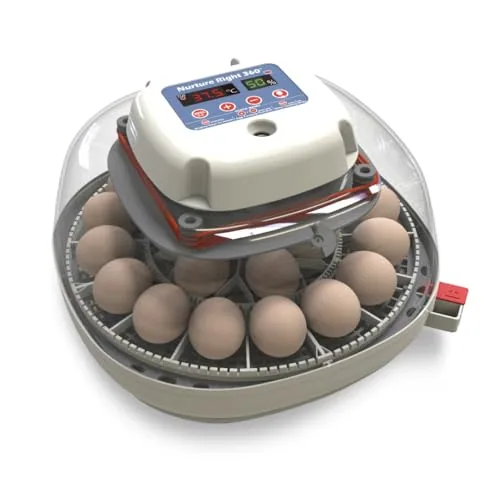
Nurture Right 360 Incubator, 22 Eggs, Auto Turner
- Egg capacity
- 22 chicken, 12–18 duck or 22–24 pheasant eggs
- Turning
- Automatic with auto-stop
- Humidity
- Display and control knob
Best for Family first hatches
Why consider it: Triple the batch: up to 22 chicken eggs, a 360° clear shell and auto-stop turning, with humidity shown on a digital display.
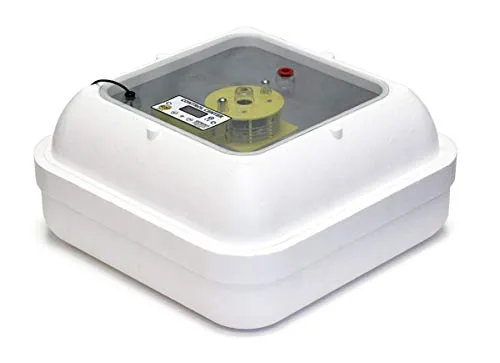
GQF 1588 Hova-Bator with 1611 Auto Turner
- Turning
- Automatic (1611 turner, 6 universal racks)
- Fan
- Forced-air (circulated air)
- Display
- Digital temperature and humidity
Best for A complete HovaBator setup
Why consider it: A larger foam incubator with GQF’s 1611 automatic turner and six universal racks, plus a digital temperature and humidity display.
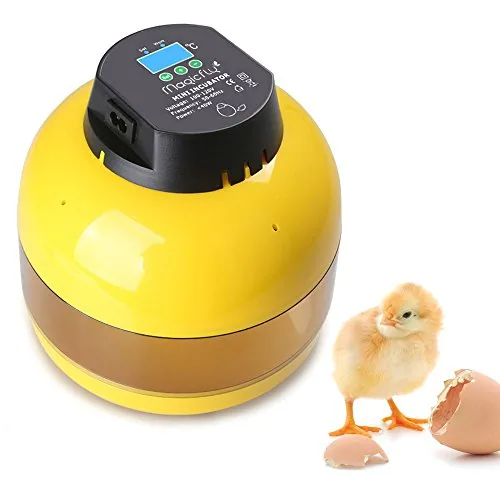
Magicfly Digital Mini 10-Egg Incubator (Manual Turn)
- Egg capacity
- 10 eggs
- Turning
- Manual
- Display
- LED display
Best for Low-cost first hatches
Very small, manual-turn hatch: Magicfly’s Digital Mini holds 10 eggs with an LED display, but you turn the eggs by hand.
We read the maker’s specs, manual and the current listing, and checked them against extension, CDC, USDA and FDA guidance where it applies. We did not hatch eggs in, house birds in, install or lab-test this product. We never show scores, star ratings or prices.