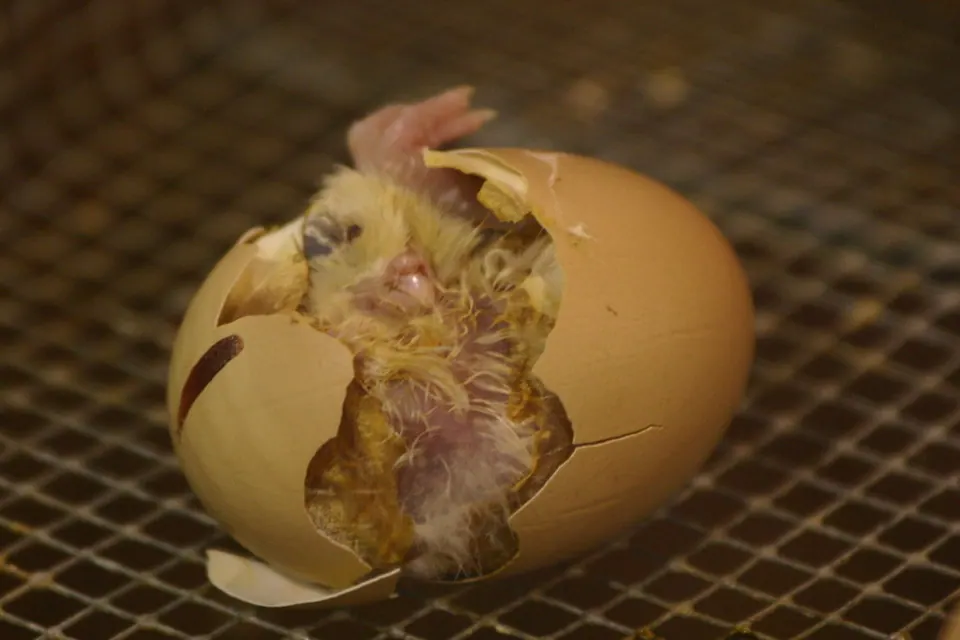
- Chicken eggs hatch in about 21 days at 100°F in a forced-air incubator; still-air models run 2–3°F warmer at egg-top height (MSU).
- Humidity targets vary by source: Brinsea gives 45–50% RH, then 65%+ for hatching; follow your incubator's manual first.
- Turn eggs at least 4–6 times a day (an odd number by hand) and stop on day 18 (MSU).
- Candle around days 7 and 14 and remove clear eggs or eggs with a blood ring (4-H, Illinois Extension).
- From day 18 (lockdown) keep the lid closed, raise humidity and open vents; hatch usually comes on day 21.
Learning how to incubate chicken eggs comes down to holding three things steady for three weeks: temperature, humidity and turning. Get those right and most of the work is waiting. Get them wrong and the hatch comes early, late or not at all.
This guide gives you the setup steps and a day-by-day plan, using Mississippi State University's incubation table, the University of Missouri's incubation guide, Brinsea's humidity guidance and 4-H embryology candling days. Where sources disagree, the rule is the same: your incubator's manual comes first, and you check its built-in display against a separate thermometer and hygrometer.
What do you need to incubate chicken eggs?
- Fertile eggs. Grocery-store eggs are almost never fertile (Missouri Extension). Buy hatching eggs from a hatchery, an NPIP-tested breeder or a local keeper with a rooster.
- An incubator. Forced-air (with a fan) holds an even temperature; still-air is cheaper but has a temperature gradient. An automatic turner with auto-stop saves a week of hand-turning.
- A separate thermometer and hygrometer. Built-in sensors drift. Use a second reading at egg height.
- A candler. A bright LED light lets you see inside the shell on days 7 and 14.
- A brooder ready by day 20. Chicks move out about 12 hours after hatching (Missouri). See how to set up a brooder.
These incubators cover the common sizes. Specs are as listed by each maker; compare more in best incubator for beginners and best egg incubators.
| Product | Egg capacity | Turning | Humidity | Fan | Display |
|---|---|---|---|---|---|
| Brinsea Mini II Advance 7-Egg Incubator | 7 chicken eggs; 12 small eggs with optional insert | Automatic with auto-stop | Manual, external water top-up | Forced-air (fan-assisted) | Digital countdown; room-temp and high/low temp alarms |
| Nurture Right 360 Incubator, 22 Eggs, Auto Turner | 22 chicken, 12–18 duck or 22–24 pheasant eggs | Automatic with auto-stop | Display and control knob | Forced-air (360° induced airflow) | Digital temperature and humidity |
| GQF 1588 Hova-Bator with 1611 Auto Turner | — | Automatic (1611 turner, 6 universal racks) | — | Forced-air (circulated air) | Digital temperature and humidity |
| Farm Innovators 4250 Circulated Air Incubator, 41 Eggs | 41 eggs | Automatic | Manual, E-Z Fill water channels | Forced-air | Temp, humidity, days to hatch; Hi/Lo light |
Specs as listed by the maker or seller; check the listing before you buy.
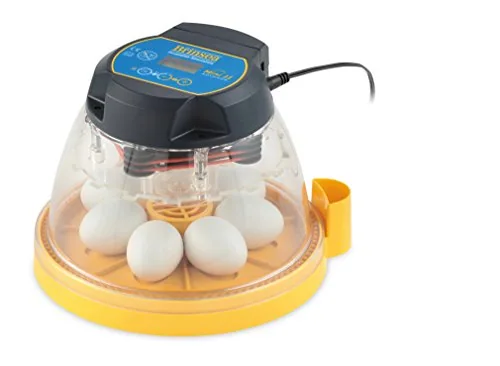
Brinsea Mini II Advance 7-Egg Incubator
- Egg capacity
- 7 chicken eggs; 12 small eggs with optional insert
- Turning
- Automatic with auto-stop
- Humidity
- Manual, external water top-up
Best for Small first hatches at home
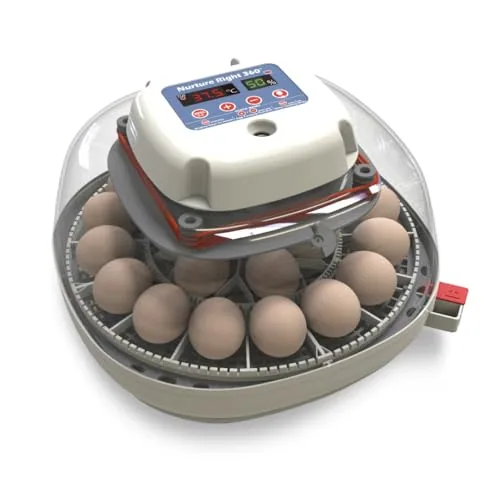
Nurture Right 360 Incubator, 22 Eggs, Auto Turner
- Egg capacity
- 22 chicken, 12–18 duck or 22–24 pheasant eggs
- Turning
- Automatic with auto-stop
- Humidity
- Display and control knob
Best for Family first hatches
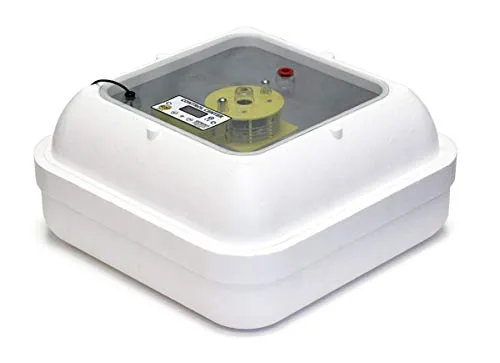
GQF 1588 Hova-Bator with 1611 Auto Turner
- Turning
- Automatic (1611 turner, 6 universal racks)
- Fan
- Forced-air (circulated air)
- Display
- Digital temperature and humidity
Best for A complete HovaBator setup
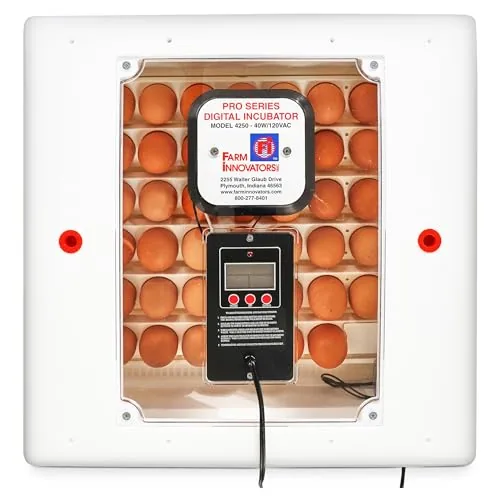
Farm Innovators 4250 Circulated Air Incubator, 41 Eggs
- Egg capacity
- 41 eggs
- Turning
- Automatic
- Humidity
- Manual, E-Z Fill water channels
Best for Mid-size hatches including waterfowl
How should you store and choose hatching eggs?
The University of Missouri gives clear storage rules. Cool eggs to 45–55°F soon after laying at about 70–75% relative humidity, store them large end up and set them within 3–4 days if you can. Never store fertile eggs longer than two weeks, and if you hold them more than a week, tilt them from side to side so the contents do not stick to the shell. A household fridge at 40–45°F is too cold and lowers hatchability.
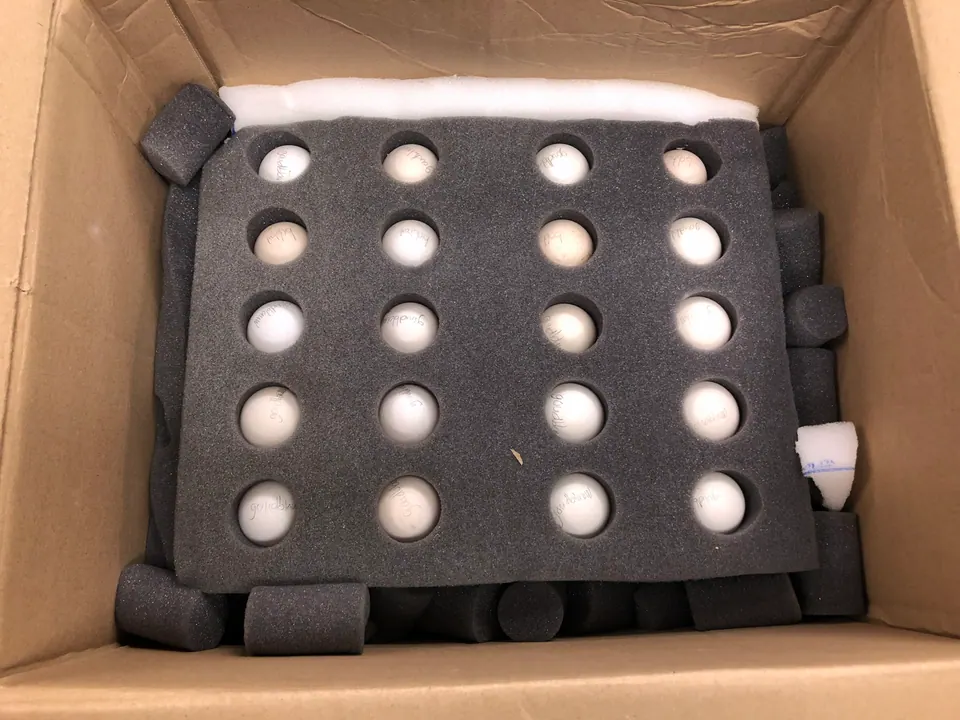
Pick clean, normal-sized, normal-shaped eggs with sound shells. Skip cracked, dirty, thin-shelled or very large or small eggs. Do not wash or sand hatching eggs: Missouri notes that this removes the protective cuticle. MSU adds that soiled eggs hatch less well and that hands should be clean and free of grease before handling eggs.
What temperature and humidity do chicken eggs need?
Here is the full species table this site uses, from MSU (days, temperature, wet-bulb, stop-turning day) with Brinsea's relative humidity figures. Chickens are the first row.
Incubation by species: forced-air settings, with the still-air offset
| Species | Days to hatch | Forced-air temp | Still-air temp | Wet-bulb, days 1 to lockdown → last 3 days | Relative humidity | Stop turning (day) |
|---|---|---|---|---|---|---|
| Chicken | 21 | 100°F (37.8°C) | 102–103°F | 85–87°F → 90°F | 45–50% → 65% or more | 18 |
| Duck (most breeds) | 28 | 100°F (37.8°C) | 102–103°F | 85–86°F → 90°F | 55–60% → 70% or more | 25 |
| Muscovy duck | 35–37 | 100°F (37.8°C) | 102–103°F | 85–86°F → 90°F | 58–60% → 65% or more | 31 |
| Coturnix quail | 17 | 100°F (37.8°C) | 102–103°F | 85–86°F → 90°F | 40–50% → 65% or more | 15 |
| Bobwhite quail | 23–24 | 100°F (37.8°C) | 102–103°F | 84–87°F → 90°F | 40–50% → 65% or more | 20 |
| Turkey | 28 | 99°F (37.2°C) | 101–102°F | 84–86°F → 90°F | 58–60% → 65% or more | 25 |
| Goose | 28–34 | 99°F (37.2°C) | 101–102°F | 86–88°F → 90°F | 58–60% → 65% or more | 25 |
| Guinea fowl | 28 | 100°F (37.8°C) | 102–103°F | 85–87°F → 90°F | 58–60% → 65% or more | 25 |
| Pheasant | 23–28 | 100°F (37.8°C) | 102–103°F | 86–88°F → 92°F | 58–60% → 65% or more | 21 |
| Peafowl | 28–30 | 99°F (37.2°C) | 101–102°F | 84–86°F → 90°F | 58–60% → 65% or more | 25 |
| Chukar partridge | 23–24 | 100°F (37.8°C) | 102–103°F | 81–83°F → 90°F | 58–60% → 65% or more | 20 |
Days, temperatures, wet-bulb and stop-turning days: Mississippi State University Extension, Important Incubation Factors. Still-air: add 2–3°F, measured at the top of the eggs (MSU). Relative humidity: Brinsea, Humidity during incubation for chickens, ducks and quail; other species show MSU's general 58–60%. Follow your incubator's manual first.
Temperature. MSU gives 100°F for forced-air incubators, with total variation kept within 1 degree, and 102°F for still-air units measured at the top of the eggs. Missouri targets about 99.5°F for forced air. Both are within the normal range; pick the figure your manual uses and hold it steady. Running warm brings an early hatch, running cool a late one, and either lowers the number of chicks (MSU).
Humidity. This is where sources differ most. Brinsea suggests 45–50% RH for chicken eggs, rising to 65% or more for the hatch; MSU's general figure is 58–60% (84–86°F wet-bulb) then 65%+; Missouri says 60–65% then 70%. The real goal is weight loss: Missouri says eggs should lose about 11–14% of their weight from day 1 to day 18. A large air cell at candling means humidity has been too low; a small one means too high.
A cheap digital hygrometer next to the eggs is the single best upgrade for a first hatch.
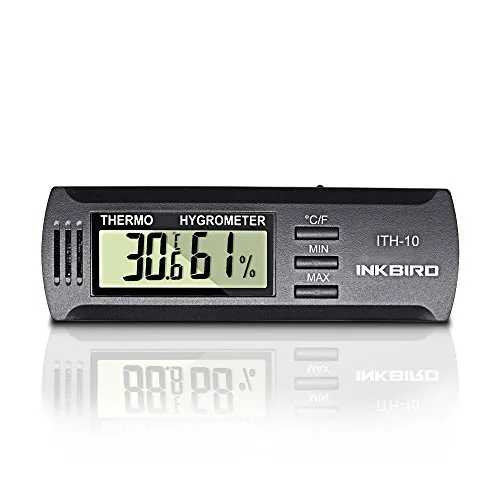
Inkbird ITH-10 Thermometer Hygrometer
- Accuracy
- ±3% RH, ±1.8°F
- Memory
- Min/max
Best for General humidity checks
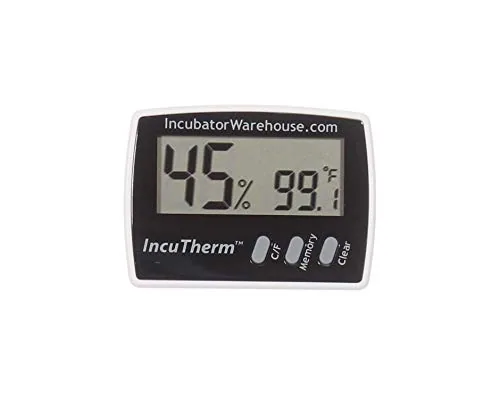
Incubator Warehouse IncuTherm Thermo-Hygrometer
- Measures
- Temperature and humidity
- Display
- Large digital, min/max memory
- Mount
- Magnetic back, pop-out stand
Best for Cross-checking an incubator's readout
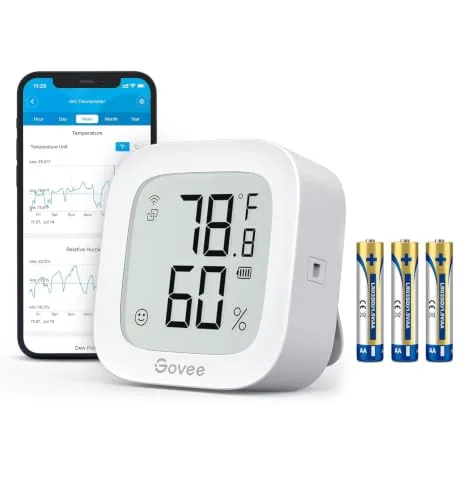
Govee H5103 WiFi Thermometer Hygrometer
- Accuracy
- ±0.54°F, ±3%RH
- Connectivity
- 2.4G Wi-Fi and Bluetooth
Best for General room monitoring
How to incubate chicken eggs: the day-by-day plan
Chicken incubation calendar
| Day | What to do | Source |
|---|---|---|
| Day −1 | Run the empty incubator for 24 hours; check temperature and humidity with a second instrument | Manufacturer manuals |
| Day 0 | Let eggs reach room temperature, then set them large end up (or on their side with the large end slightly raised). Never small end up. Write the date. | MSU |
| Days 1–6 | Hold temperature and humidity; turn at least 4–6 times a day (odd number by hand) or let the turner run. Handle gently: early embryos are fragile. | MSU |
| Day 7 | First candle. Remove clear eggs and eggs with a blood ring. | 4-H embryology |
| Days 8–13 | Keep steady; top up water with warm water as your manual says. | Missouri |
| Day 14 | Second candle. Remove eggs that stopped developing. Check air cell size against humidity. | 4-H; Missouri |
| Days 15–17 | Last days of turning. Move eggs to the hatching tray if your model uses one. | MSU |
| Day 18 (lockdown) | Stop turning, raise humidity to 65%+ (Brinsea) and open vents as the manual says. Optional quick final candle, then close the lid. | MSU; Brinsea |
| Days 19–21 | Do not open the lid. Pips appear, then zips; most chicks hatch on day 21. | MSU |
| Hatch + 12 h | Let chicks dry and fluff (about 12 hours), then move them to a warm brooder. | Missouri |
Source: MSU Extension; University of Missouri Extension G8353; Virginia 4-H embryology record sheet; Brinsea
Incubation calculator by speciesEnter your set date to get candling days, lockdown and hatch day, with a calendar file.For a record of each hatch (eggs set, developing, hatched, readings), use the printable hatch log.
How do you turn eggs, and when do you stop?
Turning keeps the embryo from sticking to the shell membranes. MSU recommends at least 4–6 turns a day and stopping for the last 3 days, which is day 18 for chickens. Missouri suggests an odd number of turns by hand (5, 7 or 9) so the egg spends alternate nights on alternate sides, and warns against rolling eggs in a full circle.
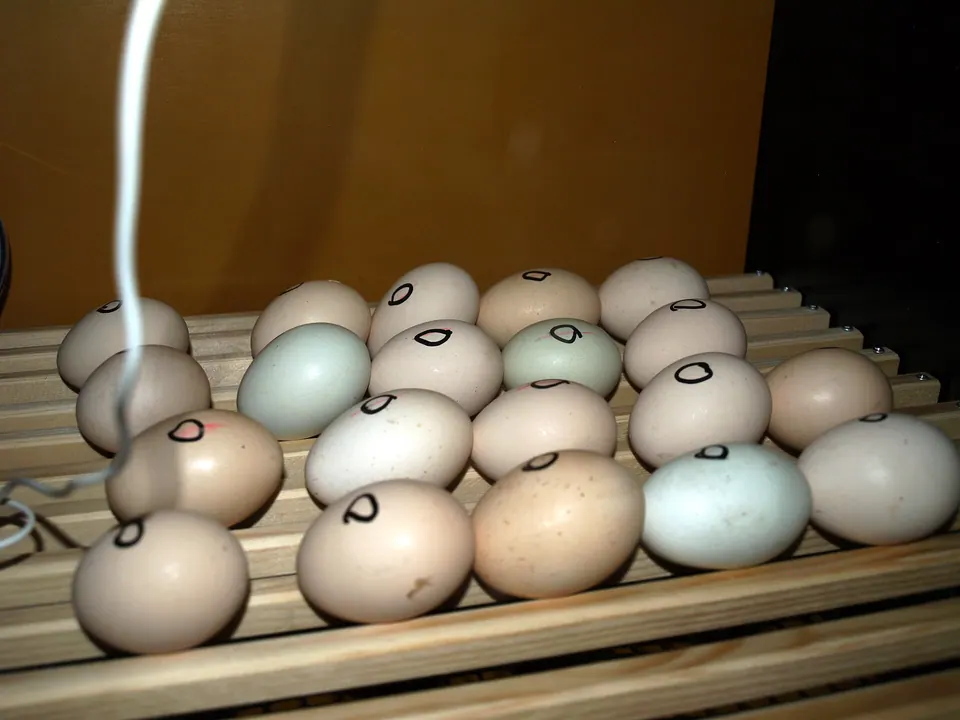
If you turn by hand, mark one side of each egg with an X and the other with an O in pencil so you can see which ones you missed. An automatic turner tray or a model with auto-stop removes the guesswork, and an add-on turner can upgrade a basic incubator. Each turner below fits specific models (HovaBator, Farm Innovators or Little Giant), so match it to your incubator.
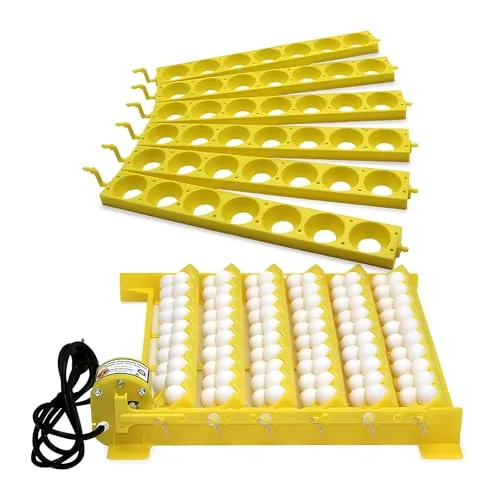
Hova-Bator GQF Automatic Egg Turner
- Capacity
- 41 eggs (6 universal racks); 120 quail with quail racks
- Fits
- All HovaBator incubators
- Includes
- Quail egg racks
Best for Automating a HovaBator
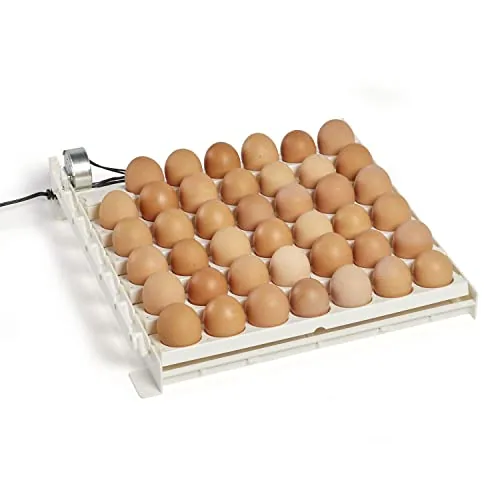
Farm Innovators 3200 Automatic Egg Turner, 41 Eggs
- Capacity
- 41 large egg cups; 120 quail with optional rails
- Turning cycle
- Full cycle every 4 hours
- Fits
- Farm Innovators 2100 and 2200 incubators
Best for Upgrading a 2100 or 2200 incubator
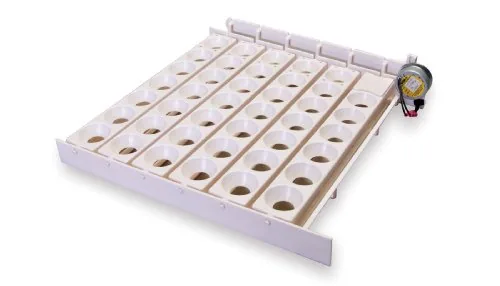
Little Giant 6300 Automatic Egg Turner, 41 Eggs
- Capacity
- 41 large chicken eggs (7 cups per rail)
- Fits
- Any Little Giant still-air or circulated-air incubator
- Cleaning
- Dishwasher-safe cups
Best for Automating a Little Giant
When and how should you candle?
4-H embryology programs candle chicken eggs on days 7 and 14, with an optional look at lockdown. Illinois Extension notes that white shells can show development as early as day 3, brown shells by day 5 or 6. A fertile egg shows a reddish spot with spreading blood vessels; a clear egg is infertile or stopped very early; a blood ring means the embryo died. Work in a dark room and keep each egg out only briefly.
The full how-to, with what each stage looks like and tips for dark shells, is in how to candle eggs.
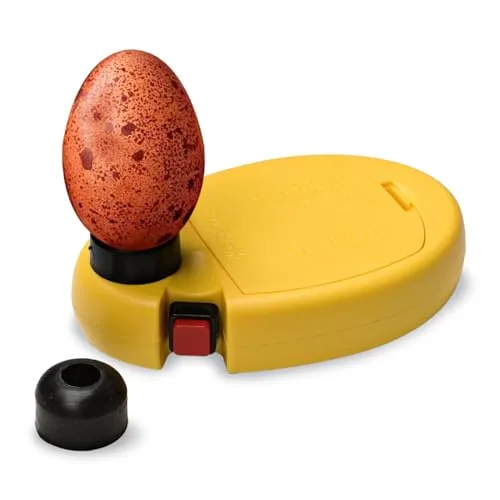
Brinsea OvaView High Intensity Egg Candler
- Light type
- Extra-bright high-efficiency LED
- Power
- 4 rechargeable AA batteries (not included)
- Best shells
- Dark or mottled (Marans, quail, pheasant)
Best for Candling dark and quail eggs
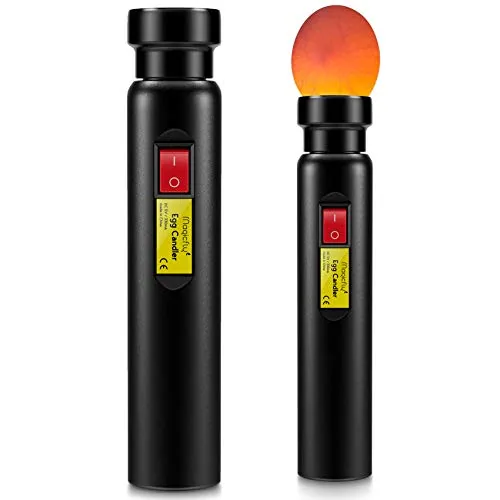
Magicfly Rechargeable LED Egg Candler
- Light type
- Cool LED
- Power
- Rechargeable (3 h charge, about 6 h use per maker)
- Covers
- Two rubber covers (duck to quail)
Best for Cordless candling
What happens at lockdown and hatch?
On day 18, stop turning, raise humidity and open vents further: MSU says to keep vents almost fully open during hatching. Then leave the lid shut. Opening it drops humidity fast, and the membranes around a pipping chick can dry and trap it. Missouri lists chicks stuck to membranes as a sign of low humidity, and chicks too weak to hatch as a sign of too much.
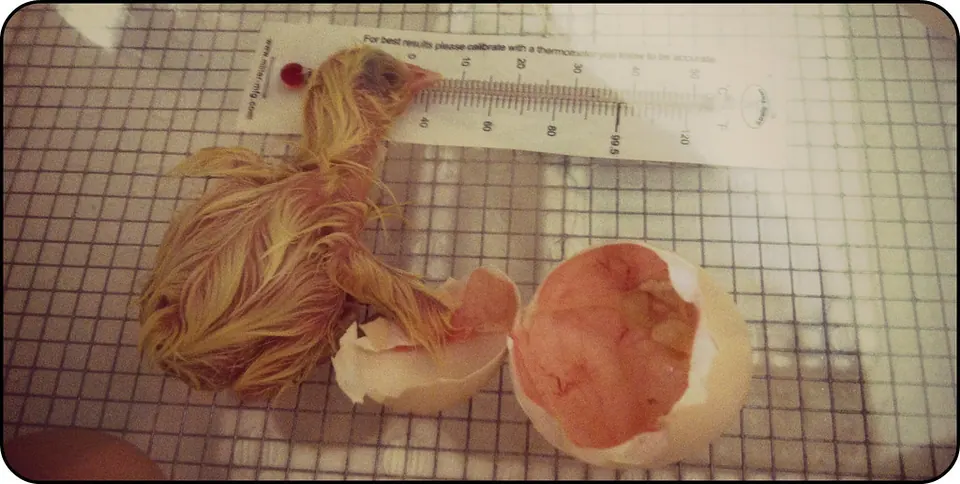
A chick first pips a small hole, then rests for hours before zipping around the shell. Do not help unless your manual or a vet advises it. Missouri notes that roughly 2 of every 10 eggs normally fail to hatch and that chicks hatching more than 24 hours after the rest are often weak. Remove leaking or cracked eggs promptly, since they can burst.
Running a hatch at school? See hatching projects at school and home and the hatching project hub.
Common incubation mistakes to avoid
- Trusting the built-in display alone. Check with a second thermometer at egg height.
- Measuring a still-air incubator at the floor. MSU's 102°F is at the top of the eggs.
- Storing eggs in the fridge or for more than two weeks (Missouri).
- Washing hatching eggs. It strips the cuticle.
- Opening the lid during lockdown. Humidity drops and pipping chicks can get stuck.
- Placing the incubator in a sunny window or drafty room. Room swings show up inside. Many manuals give a minimum and maximum room temperature.
- No plan for roosters. About half of hatched chicks are male; check your town's rules first.
- Skipping cleaning. Missouri recommends cleaning and disinfecting the incubator between hatches, keeping water out of electrical parts.
Different species? Duck, quail, turkey and goose eggs need different days and humidity; see the incubation chart by species or browse the incubation hub.
Use a forced-air incubator with an automatic turner, verify it with a separate thermometer and hygrometer, and follow the 21-day calendar: candle on days 7 and 14, stop turning and raise humidity on day 18, then keep the lid closed until the chicks are dry.
Questions
What temperature should an incubator be for chicken eggs?
What humidity do chicken eggs need?
When do you stop turning chicken eggs?
Can I open the incubator during lockdown?
How long can hatching eggs be stored before incubation?
Why didn't my chicken eggs hatch?
Should I help a chick hatch?
Sources
- Mississippi State University Extension, Important Incubation Factors
- University of Missouri Extension, Incubation of poultry (G8353)
- Brinsea, Humidity during incubation
- Virginia Cooperative Extension 4-H, Embryology record sheet (candle days 7, 14 and 18)
- University of Illinois Extension, Candling eggs
- NC State Poultry 4-H, Egg temperature chart
- CDC Healthy Pets, Backyard Poultry