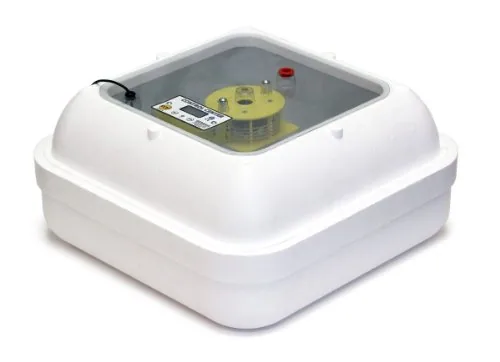
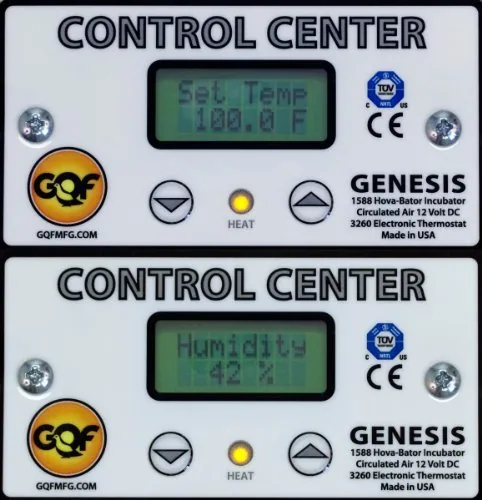
- Foam circulated-air incubator with a digital temperature, humidity and incubation-day display.
- Thermostat adjustable down to 80°F per the listing; default 100°F.
- Turner sold separately: GQF’s 1611 turner holds 41 eggs on 6 universal racks, or 120 quail with quail racks.
- Humidity comes from water you add; no alarms are listed.
- Buy the GQF-branded listing; research found look-alike “generic 1588” listings.
This Hova-Bator 1588 review covers GQF Manufacturing’s Genesis 1588, the foam tabletop incubator that many feed stores, hatcheries and 4-H programs have used for years. It is a step up in size from desktop domes and a step down in price class from cabinet incubators, which is why it is often compared with the Nurture Right 360.
We worked from the GQF listing, published retailer specs from hatcheries that sell it, the GQF 1611 turner listing and extension incubation guidance. We did not hatch eggs in one. Always set it up by the instruction sheet in the box.
Who it’s for, and who should skip it
- Want to hatch three or four dozen chicken eggs in one batch
- Prefer a circulated-air (fan) incubator with a digital readout of temperature and humidity
- Hatch ducks, quail or game birds and like an adjustable thermostat
- Already own a Hova-Bator turner, or will buy the 1588 + 1611 bundle
- Are happy to check water and temperature at least once a day
- Want an automatic turner in the box (buy the bundle instead of this listing)
- Need alarms to warn you about temperature swings
- Want a clear lid for watching the whole hatch; the 1588 is a foam box with viewing windows
- Want humidity held automatically at a set %RH
Pros and cons
- Large capacity for a tabletop incubator, about 50 chicken eggs without a turner per retailers
- Circulated air from a soft-air fan for more even heat than still air
- Digital display of temperature, humidity and incubation days
- Thermostat adjustable from 80°F, default 100°F
- Works with GQF’s 1611 automatic turner, with quail racks available
- Foam body is light and insulating
- Turner not included with this listing
- No alarms listed
- Humidity is manual: you add and refill water
- Foam is harder to disinfect than hard plastic and can dent or crack
- Nothing in the listing says the turner stops by itself before hatch
Specs
| Turning | Turner sold separately |
|---|---|
| Fan | Forced-air (circulated air) |
| Display/alarms | Digital temperature, humidity and incubation days |
| Temperature | Adjustable from 80°F; default 100°F |
As stated by the maker or seller; confirm on the listing before you buy.
What do you get with the Hova-Bator 1588?
The 1588 is a foam cabinet with a lid-mounted control center and fan. The listing describes a soft-air fan that circulates air for even temperature and oxygen. The digital control center shows real-time temperature, humidity and the number of incubation days. The thermostat is adjustable. The listing says you can set it as low as 80°F, with a default of 100°F, so you can incubate species with different targets.
This ASIN is the incubator only. GQF’s 1611 automatic turner, listed separately, holds 41 eggs on six universal racks, or 120 quail eggs with quail racks, and fits all Hova-Bator incubators. A bundle with the turner also exists (B07HCWWDVV). Without a turner, Cackle Hatchery lists about 50–70 chicken eggs laid flat, which you would turn by hand.
| Product | Turning | Fan | Display | Capacity |
|---|---|---|---|---|
| GQF 1588 Genesis Hova-Bator Incubator | Turner sold separately | Forced-air (circulated air) | Digital temperature, humidity and incubation days | — |
| GQF 1588 Hova-Bator with 1611 Auto Turner | Automatic (1611 turner, 6 universal racks) | Forced-air (circulated air) | Digital temperature and humidity | — |
| Hova-Bator GQF Automatic Egg Turner | — | — | — | 41 eggs (6 universal racks); 120 quail with quail racks |
Specs as listed by the maker or seller; check the listing before you buy.
How should you set up a Hova-Bator 1588?
- Pick a stable room
Indoors, away from windows, heaters and drafts, on a level surface. Foam insulates well, but room swings still reach the eggs.
- Assemble and run empty
Fit the floor, wire and turner (if used) as the instruction sheet shows, add water and run it for at least a day before you set eggs.
- Check the readings
Place a calibrated thermometer and hygrometer at egg height and compare them with the display. Note any difference.
- Confirm the temperature
MSU Extension gives 100°F for chicken eggs in a forced-air incubator and 99°F for turkey and goose eggs. Change the setting in small steps and wait for it to settle.
- Set humidity
Add water as the manual describes. Brinsea’s table gives 45–50% RH for chickens during incubation, 55–60% for ducks and 40–50% for quail.
- Start the count
Set the eggs and write the date in a hatch log. The display counts incubation days, but a paper record helps if power drops.
Incubation by species: forced-air settings, with the still-air offset
| Species | Days to hatch | Forced-air temp | Still-air temp | Wet-bulb, days 1 to lockdown → last 3 days | Relative humidity | Stop turning (day) |
|---|---|---|---|---|---|---|
| Chicken | 21 | 100°F (37.8°C) | 102–103°F | 85–87°F → 90°F | 45–50% → 65% or more | 18 |
| Duck (most breeds) | 28 | 100°F (37.8°C) | 102–103°F | 85–86°F → 90°F | 55–60% → 70% or more | 25 |
| Muscovy duck | 35–37 | 100°F (37.8°C) | 102–103°F | 85–86°F → 90°F | 58–60% → 65% or more | 31 |
| Coturnix quail | 17 | 100°F (37.8°C) | 102–103°F | 85–86°F → 90°F | 40–50% → 65% or more | 15 |
| Bobwhite quail | 23–24 | 100°F (37.8°C) | 102–103°F | 84–87°F → 90°F | 40–50% → 65% or more | 20 |
| Turkey | 28 | 99°F (37.2°C) | 101–102°F | 84–86°F → 90°F | 58–60% → 65% or more | 25 |
| Goose | 28–34 | 99°F (37.2°C) | 101–102°F | 86–88°F → 90°F | 58–60% → 65% or more | 25 |
| Guinea fowl | 28 | 100°F (37.8°C) | 102–103°F | 85–87°F → 90°F | 58–60% → 65% or more | 25 |
| Pheasant | 23–28 | 100°F (37.8°C) | 102–103°F | 86–88°F → 92°F | 58–60% → 65% or more | 21 |
| Peafowl | 28–30 | 99°F (37.2°C) | 101–102°F | 84–86°F → 90°F | 58–60% → 65% or more | 25 |
| Chukar partridge | 23–24 | 100°F (37.8°C) | 102–103°F | 81–83°F → 90°F | 58–60% → 65% or more | 20 |
Days, temperatures, wet-bulb and stop-turning days: Mississippi State University Extension, Important Incubation Factors. Still-air: add 2–3°F, measured at the top of the eggs (MSU). Relative humidity: Brinsea, Humidity during incubation for chickens, ducks and quail; other species show MSU's general 58–60%. Follow your incubator's manual first.
Turning and lockdown with the 1611 turner
MSU Extension says to turn eggs at least 4–6 times a day and to stop for the last three days. For chickens, that means stopping on day 18. Our sources did not say whether the 1611 stops by itself, so plan to end turning yourself as its instructions describe: take the eggs off the racks and lay them on the floor, or switch the turner off. At the same time, raise humidity for hatching. Brinsea gives 65% or more for chickens and quail and 70% or more for ducks.
The incubation calculator gives your lockdown and hatch dates for each species. Our day-by-day incubation guide covers what to do on each of the 21 days. Candle on days 7 and 14 (4-H) and remove clear eggs; see how to candle eggs.
Cleaning foam safely, and Salmonella
Foam incubators clean best gently. Unplug the unit, keep the control center dry, remove debris and down, then wash with mild soap and water and a poultry disinfectant used per its label. Rinse and let everything dry completely before storage. Avoid scrubbing pads that tear foam, and never soak the lid with its electronics.
Hova-Bator 1588 vs Nurture Right 360 and Brinsea
Against the Nurture Right 360, the 1588 holds more eggs and lets you adjust the thermostat, but you cannot watch the eggs as easily and the turner costs extra. Against a Brinsea Maxi 24 EX, the 1588 holds more eggs but has no alarms or automatic humidity. If you hatch a big batch once a year for a growing flock, the 1588 is a good fit. If you hatch small, valuable batches several times a year, a Brinsea’s safeguards are worth more. See Brinsea vs Nurture Right and best egg incubators.
Big batches mean a big brooder. Size your heat plate for the number of chicks you expect, and read our brooder setup guide before day 18. Browse the incubation hub for candlers and hygrometers, and the ducks, quail and turkeys hub if you hatch waterfowl or game birds.
Alternatives worth a look
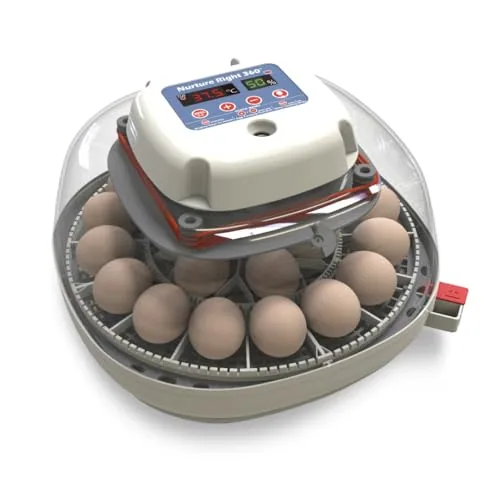
Nurture Right 360 Incubator, 22 Eggs, Auto Turner
- Egg capacity
- 22 chicken, 12–18 duck or 22–24 pheasant eggs
- Turning
- Automatic with auto-stop
- Humidity
- Display and control knob
Best for Family first hatches
Why consider it: Fewer eggs (up to 22 chicken), but the turner is included and stops by itself, and you can see the eggs from every side.
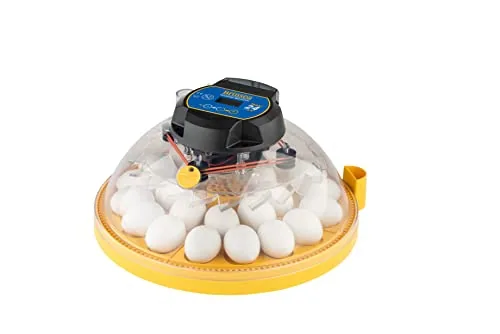
Brinsea Maxi 24 EX Incubator, Auto Humidity
- Egg capacity
- 24 chicken, 12 large, 8 jumbo or 40 small eggs
- Turning
- Automatic
- Humidity
- Automatic
Best for Keepers hatching several species
Why consider it: Automatic humidity, high/low and room-temperature alarms and quadrants for quail to goose eggs, in a 24-egg clear dome.
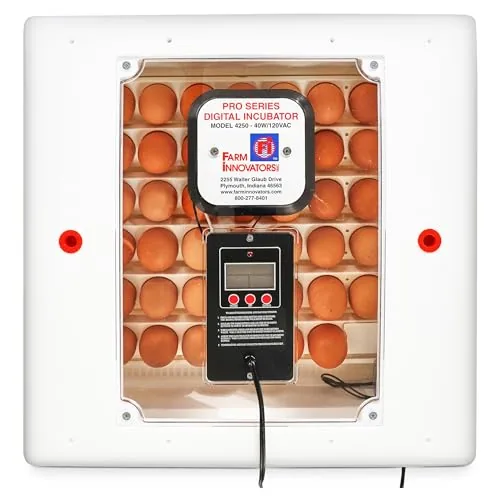
Farm Innovators 4250 Circulated Air Incubator, 41 Eggs
- Egg capacity
- 41 eggs
- Turning
- Automatic
- Humidity
- Manual, E-Z Fill water channels
Best for Mid-size hatches including waterfowl
Why consider it: Farm Innovators 4250 lists 41 eggs with an automatic turner included, E-Z Fill water channels and a days-to-hatch display.
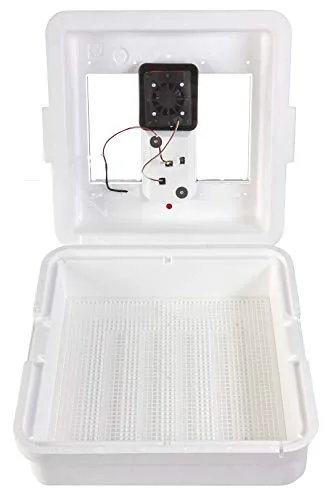
Little Giant 9300 Digital Still Air Incubator
- Egg capacity
- 41 large chicken or 120 bantam/quail (with turner)
- Turning
- Turner sold separately
- Humidity
- Built-in digital hygrometer
Best for Budget hatches, turner optional
Still-air option: Little Giant 9300 is a still-air foam incubator with a built-in digital hygrometer; turner sold separately. Still air runs 2–3°F warmer at egg-top height (MSU).
We read the maker’s specs, manual and the current listing, and checked them against extension, CDC, USDA and FDA guidance where it applies. We did not hatch eggs in, house birds in, install or lab-test this product. We never show scores, star ratings or prices.
Questions
How many eggs does the Hova-Bator 1588 hold?
Does the Hova-Bator 1588 come with an egg turner?
What temperature is the Hova-Bator 1588 set to?
Is the Hova-Bator 1588 forced air or still air?
Does the Hova-Bator 1588 control humidity?
When should I stop turning eggs in a Hova-Bator?
Sources
- GQF Manufacturing, maker of the Genesis Hova-Bator 1588 (listing text: circulated air, thermostat from 80°F, digital control center)
- Cackle Hatchery, Genesis Hova-Bator 1588 product information (capacity, preset)
- Mississippi State University Extension, Important Incubation Factors
- Brinsea, Humidity during incubation
- Virginia Cooperative Extension 4-H, Embryology record sheet (candling days)
- CDC, Backyard Poultry