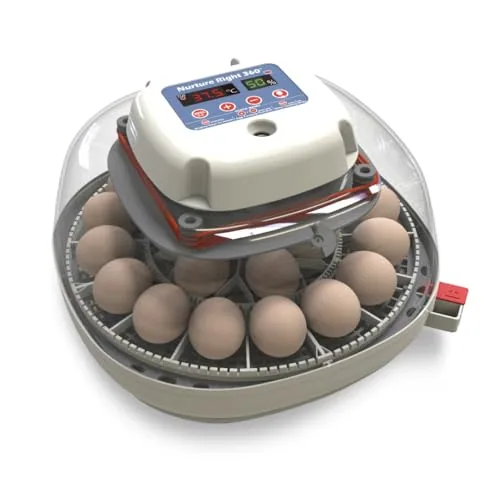
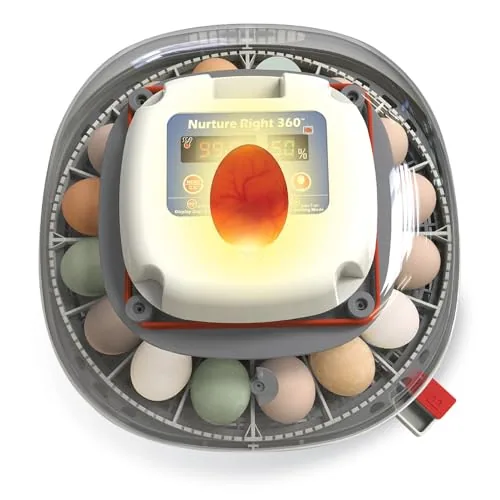
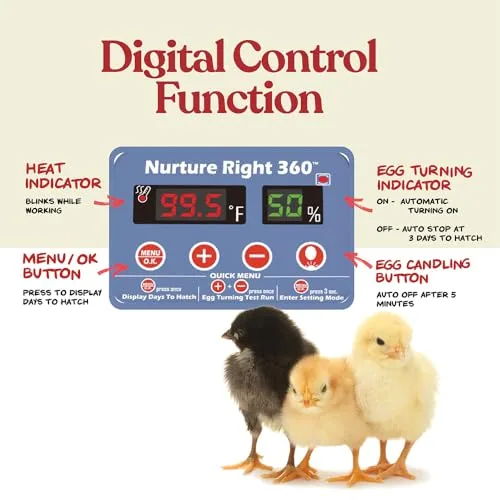
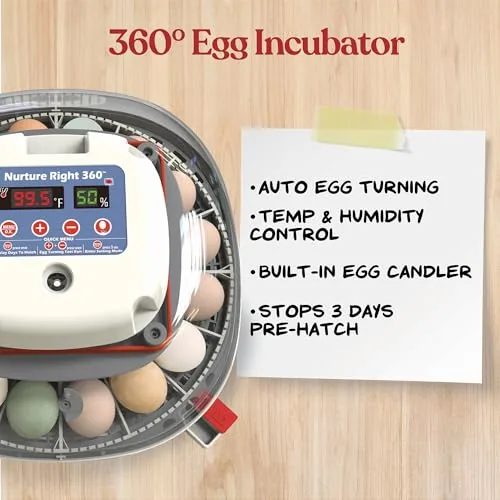
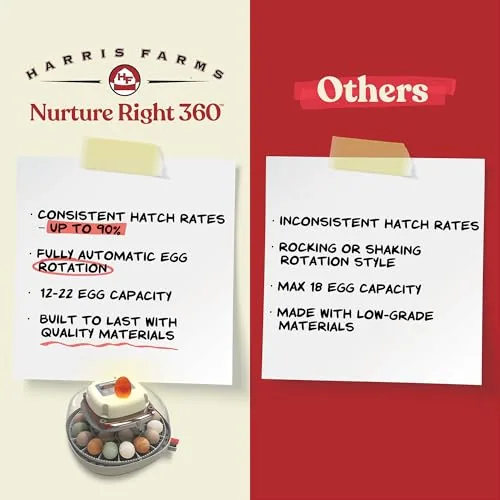
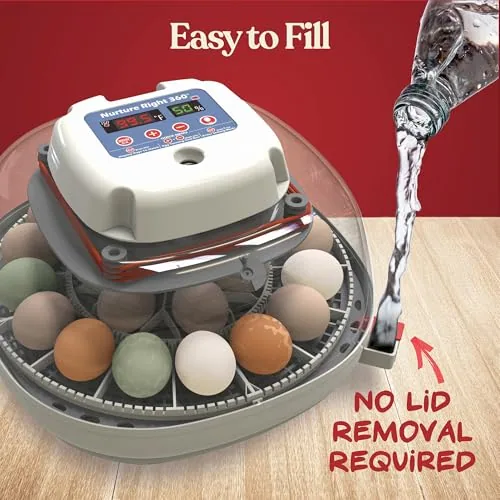
- Holds up to 22 chicken, 12–18 duck or 22–24 pheasant eggs, as listed.
- Forced-air design the maker calls “360° induced airflow”; automatic turning with auto-stop.
- Digital temperature and humidity readout, but you still add the water yourself.
- No alarms and no warranty term are listed; check readings with your own thermometer and hygrometer.
- Good fit for a first family hatch; for unattended, alarm-backed hatching look at Brinsea.
This Nurture Right 360 incubator review looks at the Harris Farms tabletop incubator, model 1030999 on the listing, now sold under the Manna Pro family of brands. Its pitch is visibility: a clear upper shell lets you see the eggs from any angle, which is part of why it shows up in so many school and family hatching kits.
We built this review from the maker’s listing, the instruction manual’s description of the turner, and extension guidance on temperature, humidity and turning. We did not hatch eggs in it. Treat it as a spec check and setup guide, not a field test, and always follow the manual that comes in your box first.
Who it’s for, and who should skip it
- Are planning a first family or homeschool hatch of one to two dozen chicken eggs
- Want to see the eggs clearly without opening the lid, which helps keep heat and humidity steady
- Like an automatic turner that stops on its own so you do not forget lockdown
- Might set a few duck or pheasant eggs too (12–18 duck and 22–24 pheasant eggs, as listed)
- Are fine checking humidity yourself and keeping a hatch log
- Want humidity handled automatically by a pump or controller
- Need audible high and low temperature alarms; none are listed
- Regularly hatch more than about two dozen eggs at a time
- Mostly hatch quail and do not want to buy a separate quail tray
- Want a long, clearly stated warranty on the box
Pros and cons
- Capacity of up to 22 chicken eggs suits most first hatches
- Clear 360-degree shell for watching eggs and pipping without lifting the lid
- Forced-air circulation, which the maker says spreads heat evenly
- Automatic turning with auto-stop before hatch
- Digital temperature and humidity readout
- Widely sold, with accessories such as a quail tray and replacement power supply available
- Humidity still depends on water you add and refill
- No high or low temperature alarms are listed
- No warranty term is stated on the listing
- Quail need an extra tray that is sold separately
- Turner parts differ between older and newer versions, so check your model before ordering spares
Specs
| Egg capacity | 22 chicken, 12–18 duck or 22–24 pheasant eggs |
|---|---|
| Turning | Automatic with auto-stop |
| Humidity control | Display and control knob |
| Fan | Forced-air (360° induced airflow) |
| Display/alarms | Digital temperature and humidity |
As stated by the maker or seller; confirm on the listing before you buy.
What does the Nurture Right 360 incubator actually include?
Per the listing, the incubator holds up to 22 chicken eggs, 12–18 duck eggs or 22–24 pheasant eggs. A turner tray sits in the base and rocks the eggs automatically. Air is moved by what Harris Farms calls 360° induced airflow, which makes it a forced-air incubator rather than a still-air one. That matters for temperature: MSU Extension’s setpoints are for forced-air machines, and still-air units run 2–3°F warmer at egg-top height.
On top, a digital display shows temperature and humidity. The listing also mentions a humidity control knob. Humidity in this class of incubator still comes from evaporating water, so the display tells you where you are and you add or remove water surface to move it. A quail tray and a replacement power supply are sold as separate accessories, which helps if a part fails mid-season.
| Product | Egg capacity | Turning | Humidity | Fan | Display |
|---|---|---|---|---|---|
| Nurture Right 360 Incubator, 22 Eggs, Auto Turner | 22 chicken, 12–18 duck or 22–24 pheasant eggs | Automatic with auto-stop | Display and control knob | Forced-air (360° induced airflow) | Digital temperature and humidity |
| Brinsea Mini II Advance 7-Egg Incubator | 7 chicken eggs; 12 small eggs with optional insert | Automatic with auto-stop | Manual, external water top-up | Forced-air (fan-assisted) | Digital countdown; room-temp and high/low temp alarms |
| GQF 1588 Hova-Bator with 1611 Auto Turner | — | Automatic (1611 turner, 6 universal racks) | — | Forced-air (circulated air) | Digital temperature and humidity |
Specs as listed by the maker or seller; check the listing before you buy.
How does the auto-turner and lockdown work?
Turning is the job people most often get wrong when they hatch by hand. MSU Extension says to turn eggs at least 4–6 times a day and to stop for the last three days. The Nurture Right handles both: the turner runs automatically and, per the listing, stops three days before hatch. The Harris Farms manual describes what happens next. When the turner stops, its indicator light goes off as a reminder to take the turner out of the base and raise the humidity for hatching.
That reminder only works if you start the count on the day you set the eggs, so write the date down. Our incubation calculator gives you the candling days, lockdown date and hatch window for chickens, ducks and other species.
Incubation by species: forced-air settings, with the still-air offset
| Species | Days to hatch | Forced-air temp | Still-air temp | Wet-bulb, days 1 to lockdown → last 3 days | Relative humidity | Stop turning (day) |
|---|---|---|---|---|---|---|
| Chicken | 21 | 100°F (37.8°C) | 102–103°F | 85–87°F → 90°F | 45–50% → 65% or more | 18 |
| Duck (most breeds) | 28 | 100°F (37.8°C) | 102–103°F | 85–86°F → 90°F | 55–60% → 70% or more | 25 |
| Muscovy duck | 35–37 | 100°F (37.8°C) | 102–103°F | 85–86°F → 90°F | 58–60% → 65% or more | 31 |
| Coturnix quail | 17 | 100°F (37.8°C) | 102–103°F | 85–86°F → 90°F | 40–50% → 65% or more | 15 |
| Bobwhite quail | 23–24 | 100°F (37.8°C) | 102–103°F | 84–87°F → 90°F | 40–50% → 65% or more | 20 |
| Turkey | 28 | 99°F (37.2°C) | 101–102°F | 84–86°F → 90°F | 58–60% → 65% or more | 25 |
| Goose | 28–34 | 99°F (37.2°C) | 101–102°F | 86–88°F → 90°F | 58–60% → 65% or more | 25 |
| Guinea fowl | 28 | 100°F (37.8°C) | 102–103°F | 85–87°F → 90°F | 58–60% → 65% or more | 25 |
| Pheasant | 23–28 | 100°F (37.8°C) | 102–103°F | 86–88°F → 92°F | 58–60% → 65% or more | 21 |
| Peafowl | 28–30 | 99°F (37.2°C) | 101–102°F | 84–86°F → 90°F | 58–60% → 65% or more | 25 |
| Chukar partridge | 23–24 | 100°F (37.8°C) | 102–103°F | 81–83°F → 90°F | 58–60% → 65% or more | 20 |
Days, temperatures, wet-bulb and stop-turning days: Mississippi State University Extension, Important Incubation Factors. Still-air: add 2–3°F, measured at the top of the eggs (MSU). Relative humidity: Brinsea, Humidity during incubation for chickens, ducks and quail; other species show MSU's general 58–60%. Follow your incubator's manual first.
Setting it up: temperature, humidity and placement
- Pick a steady room
Set the incubator on a level table indoors, away from windows, heaters and drafts. Room swings show up inside a small incubator quickly.
- Run it empty for a day
Plug it in, let it settle and compare the display with a separate calibrated thermometer and hygrometer placed at egg height. Write down any difference.
- Confirm the setpoint
For chicken eggs in a forced-air incubator, MSU Extension gives 100°F, and many makers preset 99.5°F. Follow the manual for your unit, and change settings in small steps.
- Add water for incubation humidity
Brinsea’s species table gives 45–50% relative humidity for chickens during incubation and 55–60% for ducks. Add water as the manual describes and watch the readout for a few hours before setting eggs.
- Set eggs and start the count
Load clean, uncracked eggs into the turner. Start your hatch log the same day.
- Lockdown
When the turner stops, remove it as the manual says, lay the eggs flat and raise humidity to 65% or more for hatching (Brinsea, chickens). Then keep the lid closed.
Humidity is the variable most worth watching. Too low and chicks can stick to drying membranes; too high for weeks and they hatch weak. Brinsea recommends judging humidity by egg weight loss, targeting about 13–15% by hatch day. A kitchen scale and our day-by-day incubation guide make this easy to follow.
Candling and checking progress
The clear shell lets you watch without lifting the lid, but it is not a candler. For chicken eggs, 4-H embryology guides candle on days 7 and 14, with a last look before lockdown. A bright LED candler shows veins and air cells far better than room light, especially in brown eggs. See how to candle eggs for what clear, early-dead and developing eggs look like. When you do open the lid, be quick and close it again so heat and humidity recover.
Hygiene: Salmonella and family hatches
If you are hatching with a class or young children, plan where the chicks go after hatch before you set eggs. Our school hatching guide and Salmonella and kids guide cover both.
Nurture Right 360 vs Brinsea and Hova-Bator
The usual decision is between this incubator, a smaller Brinsea dome with alarms, and a larger foam Hova-Bator. Brinsea’s Mini II Advance holds 7 chicken eggs but adds a room-temperature alarm, high/low alarms and an external water top-up. The Hova-Bator 1588 holds more eggs on its optional turner and shows temperature and humidity digitally, but it is a foam box with a small window. We compare them in detail in Brinsea vs Nurture Right, and rank more options in best incubators for beginners.
After hatch, the chicks move to a brooder. Plan your heat source now with our brooder setup guide and browse the incubation and home and school hatching hubs.
Alternatives worth a look
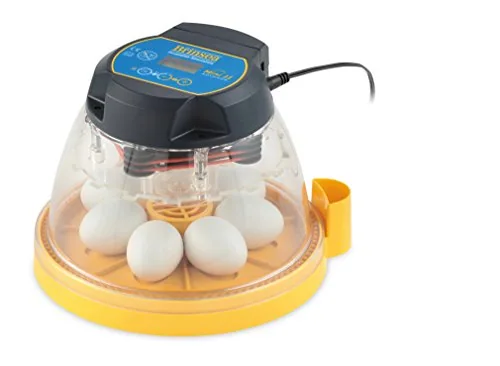
Brinsea Mini II Advance 7-Egg Incubator
- Egg capacity
- 7 chicken eggs; 12 small eggs with optional insert
- Turning
- Automatic with auto-stop
- Humidity
- Manual, external water top-up
Best for Small first hatches at home
Why consider it: Smaller batches with more safeguards: 7 chicken eggs, a hatch-day countdown, auto-stop turning and room-temperature and high/low alarms.
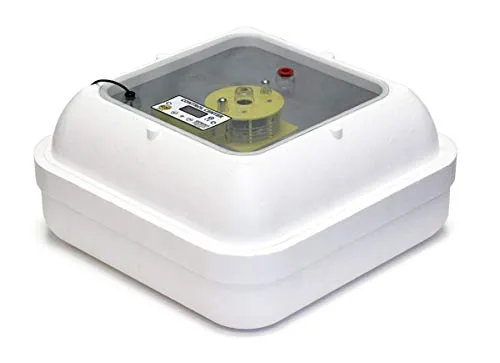
GQF 1588 Hova-Bator with 1611 Auto Turner
- Turning
- Automatic (1611 turner, 6 universal racks)
- Fan
- Forced-air (circulated air)
- Display
- Digital temperature and humidity
Best for A complete HovaBator setup
Why consider it: More eggs per hatch: the foam Hova-Bator 1588 with GQF’s 1611 turner and six universal racks, plus a digital temperature and humidity display.
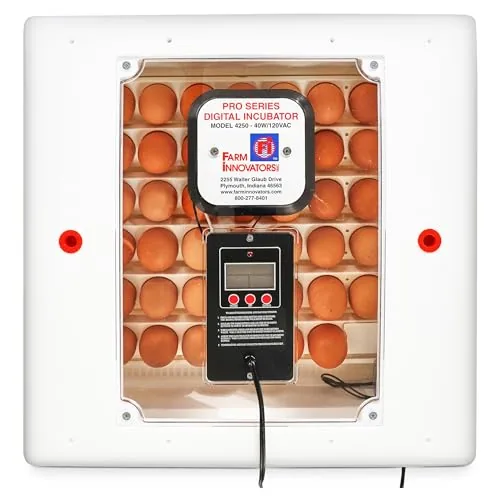
Farm Innovators 4250 Circulated Air Incubator, 41 Eggs
- Egg capacity
- 41 eggs
- Turning
- Automatic
- Humidity
- Manual, E-Z Fill water channels
Best for Mid-size hatches including waterfowl
Budget-minded larger hatch: Farm Innovators 4250 lists 41 eggs, automatic turning, E-Z Fill water channels and a days-to-hatch display.
We read the maker’s specs, manual and the current listing, and checked them against extension, CDC, USDA and FDA guidance where it applies. We did not hatch eggs in, house birds in, install or lab-test this product. We never show scores, star ratings or prices.
Questions
How many eggs does the Nurture Right 360 incubator hold?
Does the Nurture Right 360 control humidity automatically?
When does the Nurture Right 360 stop turning eggs?
What temperature should I run it at for chicken eggs?
Can I hatch duck eggs in the Nurture Right 360?
Is the Nurture Right 360 good for a classroom?
Sources
- Harris Farms Nurture Right 360 listing (model 1030999), capacity, airflow, humidity display, auto-turn and stop
- Harris Farms Nurture Right 360 instruction manual (turner indicator and lockdown)
- Mississippi State University Extension, Important Incubation Factors
- Brinsea, Humidity during incubation
- Virginia Cooperative Extension 4-H, Embryology record sheet (candling days)
- CDC, Backyard Poultry (Healthy Pets, Healthy People)